Probably not news to anyone in the know but the course will open this coming Saturday (April 22) and you know I'm going to funk up the routing so be prepared to play 1 to 5, 10, 11, 16 Green Tee, 17 and 18. The reasoning, as always, is 12 though to 14 are still wet on the shady side and we really haven't been able to get much done out there. But we've tried :
That is a greens mower that lost traction on the wet conditions that slipped over the bank on 16 fwy and became wedged in and amongst some trees. We used chains and a bunch of come-a-longs and were able to extract it without too much problem and luckily no damage.
The reason 6,7,8,9 aren't in the loop is those greens, mostly 6 and 7, would benefit with more time off before we go and get them ready for play. We have been aerating and top dressing each day the weather allows and have 8 greens left to do. As I've said before (GO HERE ) this is not the best time of year for that type of aggressive maintenance but more and more I seem to have fewer options to do what would be ideal.
I've not had any time to plug out disease spots like I did last year but with the exception of 2 green there is plenty of areas to put a pin that don't show winter damage. Good news is the greens are growing but the bad news is they are shaggy and bumpy because of aerating and dragging in the sand.
I could go into my usual song and dance/whine and complain about not having everything ready for play but I hope, as is mostly the case, players are just happy for something to do other than spy on their neighbours.....
Showing posts with label aeration. Show all posts
Thursday, April 20, 2017
Friday, August 22, 2014
The "A" word and River Update #2
The first three weeks in August were somewhat boring since two tournaments will occur two weeks apart so all we have really been trying to do is keep the grass mowed....not an easy task this year (which I guess is way better than the alternative, i.e. not having any grass to mow!).
And now for something completely different. If I had my way I would love to aerate the greens just after the August long weekend since recovery would be quick and by the time the turf began to grow new roots we would be very close to raising the HOC which would mean even more opportunity to grow roots (generally, the more roots the better turf can handle stress). The reason I bring this up relates to the condition of the fairways this year during the long heat spell we experienced. I have spent most of the summer amazed and confused at how well the fairways have looked. When you do the same thing from year to year you expect similar results so when you get those years where things are different from normal (good or bad) you sorta want to know why... at least I do!
I don't compare conditions between courses since there are so many different variables but I do ask in general what other golf courses are experiencing turf growth/health wise. If it's similar to what is happening at KGC I credit/blame the weather. If conditions are different than what KGC is experiencing I look at what I am doing different and try to come up with answers as to why things differ. To be honest, growing turf is as much an art as it is a science so many of my conclusion are complete guesses. So this year my guess as to why we had good fairways is three fold. (Oops! After re-reading that last paragraph I seem to be implying that KGC fwys are better than other golf course.....not what I mean. What I meant was the fwys at KGC are better this year than they have been other years; no arguing that point!)
River Watch
We've been able to keep one pump running by putting in about 10 to 12 man hours moving rocks. In preparation for the vacuum truck next week I had a back hoe come down and clean out directly in front of our intake. Obviously, the rain at the end of the week brought up the river and allowed me to shut off the irrigation and catch up on filling the reservoir so we are sitting pretty good for the next little bit. There is possibly some things in the works to help us with our water woes at the river but I'll keep it vague until I can give you more information.
And now for something completely different. If I had my way I would love to aerate the greens just after the August long weekend since recovery would be quick and by the time the turf began to grow new roots we would be very close to raising the HOC which would mean even more opportunity to grow roots (generally, the more roots the better turf can handle stress). The reason I bring this up relates to the condition of the fairways this year during the long heat spell we experienced. I have spent most of the summer amazed and confused at how well the fairways have looked. When you do the same thing from year to year you expect similar results so when you get those years where things are different from normal (good or bad) you sorta want to know why... at least I do!
I don't compare conditions between courses since there are so many different variables but I do ask in general what other golf courses are experiencing turf growth/health wise. If it's similar to what is happening at KGC I credit/blame the weather. If conditions are different than what KGC is experiencing I look at what I am doing different and try to come up with answers as to why things differ. To be honest, growing turf is as much an art as it is a science so many of my conclusion are complete guesses. So this year my guess as to why we had good fairways is three fold. (Oops! After re-reading that last paragraph I seem to be implying that KGC fwys are better than other golf course.....not what I mean. What I meant was the fwys at KGC are better this year than they have been other years; no arguing that point!)
- We are mowing fairways way less than in the past. Perhaps less traffic and less mechanical stress associated with cutting the fairway is allowing the turf to direct its energies into increasing stand density versus expending energy to repair damaged tissues and recuperate from mowing stress.
- The last couple years, due to staffing, we aerated our fairways very early compared to waiting until late fall. I suspect by aerating early the turf has had time to recover and establish new roots which allow it to better handle stress.
- Our continued effort in late spring/early summer to aerate, over-seed and top dress areas I know are prone to showing heat/moisture stress during the growing season.
River Watch
We've been able to keep one pump running by putting in about 10 to 12 man hours moving rocks. In preparation for the vacuum truck next week I had a back hoe come down and clean out directly in front of our intake. Obviously, the rain at the end of the week brought up the river and allowed me to shut off the irrigation and catch up on filling the reservoir so we are sitting pretty good for the next little bit. There is possibly some things in the works to help us with our water woes at the river but I'll keep it vague until I can give you more information.
Thursday, October 24, 2013
Getting my Ducks in a Row
Fall is always has an aura of panic associated with it for me. We really are fighting the calendar and losing one or two days to breakdowns, bad weather, or even late season play could have repercussions the following spring. This year the course closed Thanksgiving weekend (Oct.14); last year we closed a week after Thanksgiving weekend (Oct.14, strangely enough). Last year staff was laid off early and the fall work was completed by myself and the mechanic. Looking back I can't believe how lucky we were. This year I budgeted to keep some staff on week past closing and combined with the good weather we are ahead of normal...a good place to be.
All the greens were aerated with the deep tine aerator ( go here for past information) as usual but this time wasn't as nice as past times since most of the greens have at least 50% less root mass compared to other years so the turf was pulled up more than usual. I sort have a theory on why there is less root mass and I'll cover that later.
With the exception of #6 fairway, all the fairways were sprayed this week. Frosty morning meant I couldn't start spraying until noon but having staff to clean leaves and needles ahead of sprayer meant I could easily put down two tanks a day. That may not seem like much but you have to calculate mixing, applying, travel time, and clean up as part of those days so it can take up to 1.5 hours/tank depending mostly on travel time. The greens need one more and may get another treatment depending on weather and then they will have their sprays.
All that is left is putting out the tarps and getting up the elk "fences". Actually I am too late with respect to the elk......
All the greens were aerated with the deep tine aerator ( go here for past information) as usual but this time wasn't as nice as past times since most of the greens have at least 50% less root mass compared to other years so the turf was pulled up more than usual. I sort have a theory on why there is less root mass and I'll cover that later.
With the exception of #6 fairway, all the fairways were sprayed this week. Frosty morning meant I couldn't start spraying until noon but having staff to clean leaves and needles ahead of sprayer meant I could easily put down two tanks a day. That may not seem like much but you have to calculate mixing, applying, travel time, and clean up as part of those days so it can take up to 1.5 hours/tank depending mostly on travel time. The greens need one more and may get another treatment depending on weather and then they will have their sprays.
All that is left is putting out the tarps and getting up the elk "fences". Actually I am too late with respect to the elk......
| Elk Tracks on #4 Green |
Sunday, October 21, 2012
Fall Greens Aeration
This week had us bring in accessories from the course and start to get ready for the winter. We did some fall treatments but the weather is not great (lots of rain in forecast and 1" of rain on Friday night!) so I am trying to hold off but as we get closer to November and the colder the temperature gets I may have no choice but to spray and hope the rain stops.
We completed aerating all greens on Friday with the Verti-Drain as is the tradition. One thing I do in the fall as a pre-aeration survey is go to each green and pull a plug to see what kind of roots we finished off with. As is always the case this is a huge disappoint but it can also be helpful.
I think I've said it before, but showing pictures of your roots is sort of like posting pictures of yourself in your underwear; i.e. no more secrets, its out there for all to see. In my case I think it could be used for good instead of humiliation. As you can see we have greens with roots barely over one inch and others with more than four inches. A bulk of them fall into the 2 to 3 inch range. I am going to reference the rooting situation in later posts, especially as it relates to making maintenance decision in the summer but for this time out the I want to explaining the importance of root depth and how it impacts the greens aeration in the fall.
Short lesson: aeration from a Verti-Drain (in the manner we did this fall) is more for compaction relief, especially at depths greater than a more traditional aeration.
The tine in the preceding pictures is 10" long and in the first picture I can only push it in about 4" but after aeration the soil has been loosened enough that the tine easily penetrates to a depth of 8". Notice that the tine is in between the holes. This shows the real benefit of this type of aeration in loosening the entire soil profile and not just the area where the tine leaves a hole. Anyways, the importance of knowing the condition of the root zone before aeration helps when we decide what depth to aerate and whether or not to add "kick" (this aerator can be set to give a little "oomph" at the bottom of its stroke to further loosen the soil). We've found out the hard way the greens with shallow roots really don't like a deep Verti-Drain aeration and really don't like kick. Greens like 2, 7, and 12 were the worst this fall so instead of a deep tine we went traditional and pulled a core with the hopes of increasing roots mass since, for these greens, relieving compaction past the rooting depth of one inch seems silly. There is lots more to discuss here but maybe later.
We completed aerating all greens on Friday with the Verti-Drain as is the tradition. One thing I do in the fall as a pre-aeration survey is go to each green and pull a plug to see what kind of roots we finished off with. As is always the case this is a huge disappoint but it can also be helpful.
| 2 Green |
| 5 Green |
| Père Noël on the Verti-Drain |
| Pre Aeration Depth |
| Post Aeration Depth |
Wednesday, September 5, 2012
Back Where We Started.....
No water again. Obviously the material plugging the intake is more encompassing than I can see. The excavator will have to be mobilized again and remove more material after which we can, hopefully, fire up the river pumps and start drawing water. During the initial excavation the volume and depth of water made a more extensive excavation very difficult so the choice was made to wait for the river to drop before completing the maintenance of the intake. Traditionally the volume of water passing by the intake has been similar to what it is now and we were still able to pump.
This time, even with the level of water in the river is relatively good, a single pump can shut down after only 15 minutes operation. Again, something more is going on than I can see. The plan is to address this by weeks end and hopefully resolve the issue and replace the boulders and be ready for next years run off. I'll be limiting irrigation again to stretch out the available water in the reservoir. I'll keep you updated.
As forewarned, we began aerating fairways today. This process is far earlier than usual but the drive to control expenses moved the aeration up. By next Wednesday a portion of staff will be finished for the year and without bodies the chances of completing the fairway aeration by starting at the more traditional time of late September would be very slim. Not aerating to save money would be a poor choice since the benefits of aeration, although not immediately obvious, are still dramatic and help in creating a better playing surface and healthier turf.
Based on hours from last year, the wage cost of a fairway aeration was around $13.50/hr for 131.5 hrs for an amount of $1775 and close to $250 in fuel for a total just over $2000 (because I am tracking fuel usage more closely this year I should be able to calculate a more accurate number for the actual cost per hour). The important thing to remember is no extra staff is brought in, no over time is needed, and there is no other extra expenses (i.e. material goods such as sand, etc.) except for fuel. For the next few weeks staff is still needed to mow and maintain the course so a wage savings by not aerating would not be there for September. The only difference this time out we are doing more of the fall work "in golf season", if you will. Any savings will be realized in October by running a smaller staff then since some of the regular fall work will have been completed.
| September 5, 2012 |
| September 6, 2011 |
| September 9, 2010 |
Based on hours from last year, the wage cost of a fairway aeration was around $13.50/hr for 131.5 hrs for an amount of $1775 and close to $250 in fuel for a total just over $2000 (because I am tracking fuel usage more closely this year I should be able to calculate a more accurate number for the actual cost per hour). The important thing to remember is no extra staff is brought in, no over time is needed, and there is no other extra expenses (i.e. material goods such as sand, etc.) except for fuel. For the next few weeks staff is still needed to mow and maintain the course so a wage savings by not aerating would not be there for September. The only difference this time out we are doing more of the fall work "in golf season", if you will. Any savings will be realized in October by running a smaller staff then since some of the regular fall work will have been completed.
Saturday, April 21, 2012
Opening Update for Week of April 22
A short note as opening day nears. The course will open the front nine on Wednesday, April 25. All greens will be in play but not necessarily all the bunkers (same old, same old). We have aerated and top dressed 11 greens and will finish the rest off next week in anticipation of all 18 holes opening for Saturday, April 28.
Aside from the aerating we will continue with starting up irrigation, cleaning up tree litter, preparing the bunkers, and mowing turf. Mostly things are good with some nuisance problems on a few greens. I'll go into more detail once as the opening date gets closer.
Sunday, November 6, 2011
Some More Fall Activities Picts
So far the fall has been fairly typical work and weather wise. We were able to deep tine all the greens again this fall with 3/4 inch solid tines. Because we've been using this type of aeration for a few years now we were able to go as deep as 10 inches on certain greens with no detrimental effects.
| Verti Drain Operating on #1 Green |
Some of the greens (those with a little or no substance to their root zone) have a tendency to overly "puff up" when aerated at too deep a depth. For those greens we lessened the depth and slowed the tractor which seemed to help keep the turf in place. This time out we also rolled the greens with the tractor and aerator after we finished aerating and that really seemed to help lessen the "puffiness" factor.
| Cleaning up Ponderosa on #6 Fairway |
| Hauling Logs From #15 Green |
As before, we will take the infected trees and process them in some fashion so as to kill the beetle.
Saturday, September 24, 2011
What's new.
This past week has been very busy and my time has been spread pretty thin so some stuff got put back burner. As I threatened last post, we have begun to aerate this week. We will begin with the fairways (see The Down Hill Slide....from 2010 for information on why) and will move onto greens starting the week of the 25th.
The tournament schedule leading up to last week sort of played with our falling spray program dates and, as a result, we have quite a bit of Fusarium (again, see posting from 2010 title Week of May 23 for more info on Fusarium) on the greens but we did get the first of our treatment down at the beginning of the week and now all we have to do is grow out the damage from this bout of disease and keep up with treatments on our normal fall schedule.
If you've played this week you probably noticed the work going on at the range. I was waiting until I posted anything about the project but that is just stupid because if I wait until it is done everyone will have found out for themselves, or worse, through the rumour mill about what is going on. I'll treat the project like the "River Updates" and rehash the week and give notice of what is to come the following week so people know what's what.
Driving Range Update
Firstly why the range and why now? The "why the range" was touched on in last weeks post (see Update). Why now? The quick and dirty answer might be something along lines of "best bang for the buck". Few other projects discussed by the Strategic Planning committee and presented to the Board of Directors had the same cost to potential revenue ratio (if there really is such a ratio?!). A new green or new tee would update the layout but, unless you're planning to do nine new golf holes, I'm not sure how much more play building or updating a single tee would bring in (not saying we don't need to do that, but that is whole new topic!), A driving range can add to the bottom line of a golf course in many ways. People buy driving range passes on top off their regular seasons pass and if your range is suitable people will come and practice even if they aren't members. The more people that hang around the club the greater the exposure and the better off the club will be in many aspects including membership numbers and extra revenue. Furthermore, a suitable range opens up numerous opportunities for offering special lessons and even the development of multi day clinics which again means more people spending time at KGC.
Right now the bulk of the work is stripping the old sod and moving material. We don't have the equipment to do that so we brought in a bulldozer to rough shape the range.
The tournament schedule leading up to last week sort of played with our falling spray program dates and, as a result, we have quite a bit of Fusarium (again, see posting from 2010 title Week of May 23 for more info on Fusarium) on the greens but we did get the first of our treatment down at the beginning of the week and now all we have to do is grow out the damage from this bout of disease and keep up with treatments on our normal fall schedule.
If you've played this week you probably noticed the work going on at the range. I was waiting until I posted anything about the project but that is just stupid because if I wait until it is done everyone will have found out for themselves, or worse, through the rumour mill about what is going on. I'll treat the project like the "River Updates" and rehash the week and give notice of what is to come the following week so people know what's what.
Driving Range Update
Firstly why the range and why now? The "why the range" was touched on in last weeks post (see Update). Why now? The quick and dirty answer might be something along lines of "best bang for the buck". Few other projects discussed by the Strategic Planning committee and presented to the Board of Directors had the same cost to potential revenue ratio (if there really is such a ratio?!). A new green or new tee would update the layout but, unless you're planning to do nine new golf holes, I'm not sure how much more play building or updating a single tee would bring in (not saying we don't need to do that, but that is whole new topic!), A driving range can add to the bottom line of a golf course in many ways. People buy driving range passes on top off their regular seasons pass and if your range is suitable people will come and practice even if they aren't members. The more people that hang around the club the greater the exposure and the better off the club will be in many aspects including membership numbers and extra revenue. Furthermore, a suitable range opens up numerous opportunities for offering special lessons and even the development of multi day clinics which again means more people spending time at KGC.
Right now the bulk of the work is stripping the old sod and moving material. We don't have the equipment to do that so we brought in a bulldozer to rough shape the range.
Pushin' the old tee deck
Prior to stripping material we dug out all the irrigation heads (24 in total) and will re-use those when we add back new pipe to the range. We also took the time to remove the perennials on the back of the tee and will use those around the golf course.
Bucket O' Perennials
Next post will have some information on how much material we needed to move but until then the following picture shows how much material was moved after one day (and, FYI, at the point this picture was taken we weren't even half way!)
Wildlife
On Thursday we got to watch the cubs and their "mom" devour some of the chokecherries around the putting green. Next to 3 green they demolished the Schubert chokecherry tree. I think I may have to admit that a Schubert is a poor choice for a tree at KGC.
River Watch
September 24
The flow is so low now that we can't even pump 130 GPM any more. At present, we have had to use one of the control valves to limit the pump station output to 100 GPM. I guess the good news is the reservoir is mostly full and the water demands are somewhat limited. I am not having much luck getting hold of the necessary government departmental representatives to line up the required permits to perform the obviously needed work at our intake. I'll keep trying and, hopefully, things fall into place before next April or, worst cast, next August.
Thursday, September 8, 2011
Not so exciting times
My dad says there is a Chinese curse that says something along the lines of "may you live in exciting times". Keeping that phrase in mind I can honestly say over the past couple weeks we've been blessed and definitely not cursed. Events on the the golf course have been extremely typical almost leaning towards boring. With summer staff leaving we don't really have the staff for small projects such as the paving block work we've been doing around the ball washer areas at the tees. Most of our time has been spent doing routine maintenance.
I've done a very preliminary scout of "beetle trees"and have found more. The most disturbing find so far is next to 6 green where a very large Ponderosa pine was hit hard by the beetle. This is the first large tree on the front nine to be attacked. Its location next to the road, power lines, and 6 green may result in us having to remove some extra trees to get it to fall where it will do the least damage. We will start to visit the usual areas and by the end of September I should have a good idea of how many trees we need to fall.
Dying Ponderosa on the Right
The club is hosting a regional tournament this Saturday so we won't start anything too crazy but be forewarned it is time to aerate. We will start by picking away at the fairways and then start in on the greens by the third or fourth week in September. There is some projects bubbling away on the back burner and if those heat up I may need to move regular fall preparation up a week or two.
River Watch
August 28
September 8
We've been running on one pump (about 230 GPM) since the end of August and have been able to keep up with the golf course demand. This past Monday we had the first low wet well shutdown. I was able to adjust the flow down to 180 GPM but that only lasted a day and the pumps shutdown again. I had to decrease the flow further to 120 GPM to keep the one pump filling the reservoir . We brought down a crew of 4 and after a couple of hours of moving rocks and we able to increase the flow near the intake allowing me to operate the pumps at around 180 GPM. This is only the first of many visits to keep the water flowing so stay tuned for more updates.
Thursday, August 4, 2011
More holes
I could include the usual pre-amble regarding lack of posts over the last couple weeks (not much happening, staffing, etc., etc.) but it never changes so I won't bother going into any detail.
We started to aerate the tees this week as well as needle tine the greens with our deep tine aerator the same as we did last year (see deep tine ). Both are fairly low key events and will be followed by a light top dressing on the greens next week and and a heavy top dressing on the tees.
Obligatory Aeration/Clean up
Picture for the Tees
A little follow up to the from our spot fairway aeration I referenced during the July 7th post.
This picture was taken July 17th and shows all the little sprouts from the overseeding coming up. With the possible exception of the aeration on the left of 14 fairway all other areas are looking great and the whole process has allowed me to back off the water in these areas as well as eliminate any extra hand watering. This is something we will start up again in September when the timing is better.
The fox is still around and has made the local paper. In the following picture the fox is within arms length and was busy eating a mouse.
This picture was taken July 17th and shows all the little sprouts from the overseeding coming up. With the possible exception of the aeration on the left of 14 fairway all other areas are looking great and the whole process has allowed me to back off the water in these areas as well as eliminate any extra hand watering. This is something we will start up again in September when the timing is better.
The fox is still around and has made the local paper. In the following picture the fox is within arms length and was busy eating a mouse.
River Watch
Here we go again. I'm optimistic that with the level it is now and the the fact that it is already August we should have no problems but I want to keep a record and this is a good vehicle for doing that.
Something different from this springs run off was the deposit of a log just outside the intake. The angle is perfect but if I could choose I would place it 300 yard up stream so the log could continue to direct the flow of the water to the intake as the river level dropped.
Here we go again. I'm optimistic that with the level it is now and the the fact that it is already August we should have no problems but I want to keep a record and this is a good vehicle for doing that.
Something different from this springs run off was the deposit of a log just outside the intake. The angle is perfect but if I could choose I would place it 300 yard up stream so the log could continue to direct the flow of the water to the intake as the river level dropped.
Thursday, July 7, 2011
More aeration
What to write about when nothing seems new? I guess I could do a quick review of the past couple weeks. We continued with aerating other spots once the greens where done. I made mention of why we aerate and top dress the collars and aprons in the past (see aerating collars) and the same reasons still hold true this time out.
We also took the time to aerate select spots on the certain fairways. We've done this many times in the past during early summer and it has resulted in better conditions during the remainder of the season for those select spots. We choose areas that a prone to drying out and, as a result, require extra work to keep them playable and looking good. We try to punch as many holes as possible and then overseed those areas with a blend of bluegrass/rye grass seed. I like to reuse the cores we collect from the spring greens aeration mixed with one part Nature's Gold (commercial compost composed of ..... you don't want to know but if you know someone in Kelowna chances are pretty good some of their "business" is on our fairways) and one part sand. We lay it on pretty thick with the hope of filling the newly created holes. The top dressing will also cover the seeds which helps give a better catch.
Aerating and Cleaning Cores
at Lone Pine
The next area to see the aerator will be the tees but I think everybody needs a bit of reprieve so chances are we won't be doing tees until the end of July. at Lone Pine
One more quick comment about the greens aeration. I can see with the benefit of hindsight that the greens at KGC didn't really respond the way I had hoped. Although they are growing well with lots of grass and new roots are starting to appear they are still too soft. With the heat arriving last weekend I was happy with how well they coped, however, that was short lived and now we are having to hand water LDS (Localized Dry Spots) like crazy. Ultimately, the greens will be better off but my preference would be to not deal with the problems we are facing now. This falls aeration will not be as aggressive as I alluded to in the last post but more likely a repeat of the 2010 fall aeration (2010 fall aeration)
4 Green Surface
Saturday, June 25, 2011
Aerating Greens
On Monday and Tuesday of this week (and Wednesday also, actually) we aerated all greens. It's now Saturday and time for an early assessment of the process.
Day One
We followed the same idea as last year and only required 3 guys to aerate the greens and pick the cores.
Cleaning Up Cores

Surface Immediately after
Aerating
Some greens dried out more than others following aeration and on those stressed greens the larger holes remained prominent. Again, more sand would have helped here.
Day 4

Day One
We followed the same idea as last year and only required 3 guys to aerate the greens and pick the cores.
Cleaning Up Cores
Surface Immediately after
Aerating
The pattern we tried this time out was a tight 1.5" X 1.5" with an 3/8's - 3/4's cross tine set alternating with a 1/4 - 1/4 side eject set. With that combination of tines we pulled three 3/8's and four 1/4" cores and punched three 3/4 slices per holder for a total of forty-two holes and eighteen slices over the width of the aerator. Using an average size green at KGC and it works out to be 600,000 holes over the entire surface but because we used some cross tines (FYI cross tines just punch a hole in the shape of an X and don't remove any material) we really only pulled an average of 420,000 cores per green.
Day 2

2 Days After Aeration and
1 Day After Sand Top Dressing
We top dressed in two direction at a medium rate. I think that may have been a mistake since the larger holes may be too big to disappear in a timely fashion. My concern was adding too much sand and then end up stressing the greens while trying to incorporate/disperse the excess sand. We've done that before and that process comes with its own set of headaches.
Day 3
Day 2
2 Days After Aeration and
1 Day After Sand Top Dressing
We top dressed in two direction at a medium rate. I think that may have been a mistake since the larger holes may be too big to disappear in a timely fashion. My concern was adding too much sand and then end up stressing the greens while trying to incorporate/disperse the excess sand. We've done that before and that process comes with its own set of headaches.
Day 3
Day 4
Not really a whole lot different from the previous day. Although the weather was cool following aeration I don't really think that impacted recovery. The visible holes in the above picture are from the 3/8 's tines.
I guess good news is all the greens appear healthy and are growing. They are very soft not only from the aeration but also from all the extra water they are getting as we try to limit drought stress. We will have to top dress again but you won't notice. The mechanic, however, will since the reels will need extra sharpening this week. We will have play a bit with tine selection before our next aeration in the fall. We aerated the new putting green with all 3/8's on a 1.5"x1.5" spacing and it handled it not too bad. I know not every green on the course could handle that spacing but based on this aeration we may try using 1/4" tines on the 1.5"x1.5" spacing instead and see what comes of that.
Saturday, June 18, 2011
It's been long time.
There hasn't been any new posts for a variety of reasons but the main one is that not much has been going on. The weather has put a damper on the play and some of our activities but it has made it easy to grow grass. I sort of feel guilty when all we have to do is mow. Heck, we haven't even had to water. It is getting so bad that the grass is starting to grow over our irrigation heads!
Starting this week things will change slightly since that is when we begin to aerate the greens. Last years spring aeration was fairly successful so we will try something along the same lines but with some changes (see July 8, 2010 for more info) . We weren't able to do the amount of aerating I was hoping last year so only using small 1/4" tines each time out would eventually catch up to us. We are going to try a combination of last springs and last falls aeration's which means just a few more big (3/8's) tines versus all little tines. As a demonstration we aerated the old putting green on Monday and saw positive results.
Putting Green Five Days
After Aeration
After Aeration
The decision on what combination of tines we use is based on the reasons why we are aerating and general health of the turf. As mentioned in older posts, this type of shallow aeration is mostly for thatch removal, compaction relief, and increased oxygen exchange in the upper root zone. I'll tell you a secret if you promise not to tell the other superintendents....most of our roots, if not all, are only in the top 2 - 3 inches of our greens. Pulling a core that is 5 to 6 inches deep just ends up puffing up the surface since there are no roots to hold down the turf at that depth. Unfortunately, it's sort of a chicken and egg argument: you won't have deeper roots if you don't give them somewhere to go and you can't pull a deep core unless there is a deep enough root mass. We could always pull a deep core and just deal with puffy greens but it my job to find a happy medium between beneficial maintenance practices and playability. By using a tighter spacing and removing more material we have been slowly increasing root mass in the top couple inches (I make that bold statement based not on any hard empirical data but more on off-hand observations such as general firmness, slightly longer times between watering, and visual observation of root mass). Ultimately, with the help of deep tine aeration and slowly increasing the depth at which we pull a core I hope to increase root depth. However, with a mostly Poa annua grass and suspect irrigation coverage I'm sometimes just happy to see the mowers getting any grass at all!
Tuesday, October 5, 2010
The Down Hill Slide.....and Now the Work Begins!
Starting a far back as the first week of September we began our fall aeration program. This years weather and staffing constraints caused us to shuffle the aeration schedule around a bit but we are now on the final leg. Properly timed fall aeration (ample recovery time) can be a real benefit for the fall health of the turf. Usually, a season of play and maintenance cause the soil conditions to be less than optimal for growing healthy turf (see July 8th posting for more aerating info). Aerating will decrease compaction and result in better air exchange within the root zone. In conjunction with the increased height of cut and the turfs growth habit in the fall the benefits of aerating will encourage root development and carbohydrate storage for overwintering.
We started first with the tees. There is a little bit more of a B.S. factor for tees and, as a result, we are a little less concerned about impacting playability and pulled a fairly large core. We top dress the tee's with recycled aerating cores from our spring greens aeration. That is one of the good things about being an old Poa golf course; you can recycle things like aeration cores and not worrying about spreading Poa seeds since it is everywhere already!
For the greens this time out it was all about the core. I was too scattered brained to take any pictures but we used a 3/8 tines on 1.5x2 spacing with an extra tine every second row resulting in a 1.5x1.5 spacing for those rows. Sounds confusing but all I'm really trying to say is we had more and bigger holes than the last time we pulled cores (again, see July 8th. FYI the spacing I commented on in that post was incorrect. It should read 1.5x2 spacing). The end result was a very large volume of material and more open holes for air exchange.
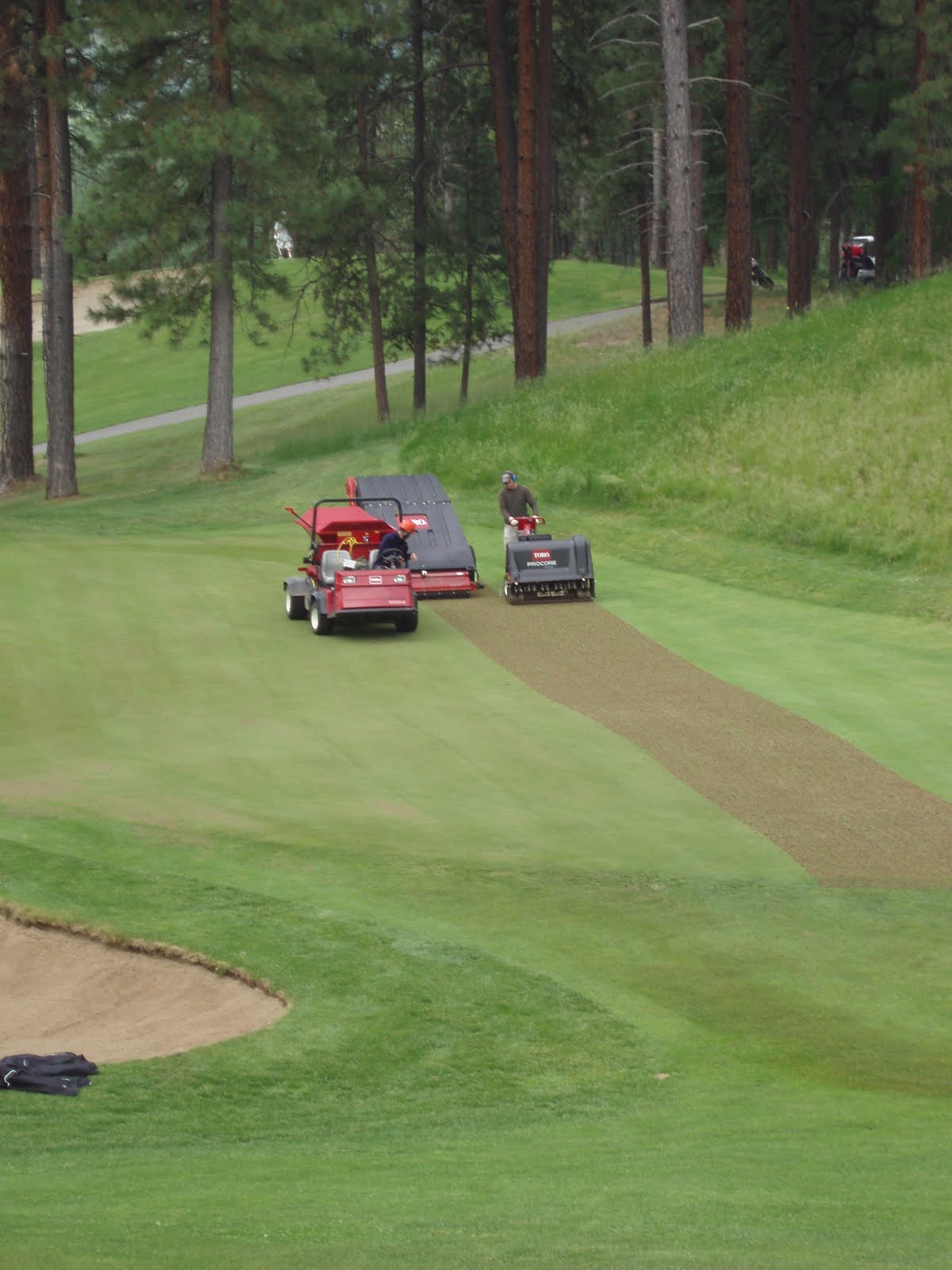
The past couple weeks have seen us pick away a aerating the fairways. We use slightly different aeration equipment for large area such as fairways that is best explained as a hollow aerating tines on rotating drums.
We started first with the tees. There is a little bit more of a B.S. factor for tees and, as a result, we are a little less concerned about impacting playability and pulled a fairly large core. We top dress the tee's with recycled aerating cores from our spring greens aeration. That is one of the good things about being an old Poa golf course; you can recycle things like aeration cores and not worrying about spreading Poa seeds since it is everywhere already!
For the greens this time out it was all about the core. I was too scattered brained to take any pictures but we used a 3/8 tines on 1.5x2 spacing with an extra tine every second row resulting in a 1.5x1.5 spacing for those rows. Sounds confusing but all I'm really trying to say is we had more and bigger holes than the last time we pulled cores (again, see July 8th. FYI the spacing I commented on in that post was incorrect. It should read 1.5x2 spacing). The end result was a very large volume of material and more open holes for air exchange.
The past couple weeks have seen us pick away a aerating the fairways. We use slightly different aeration equipment for large area such as fairways that is best explained as a hollow aerating tines on rotating drums.
Pulling a core with the Fairway aerator
This style of aeration is beneficial for its speed and simplicity. It does pull a core to remove thatch and allows increase air and water exchange but offers little in terms of compaction relief. The good thing about the recent weather leading up to the nice spell we are experiencing now is the rain made the ground nice and soft which is allowing us to pull a good 3 to 4 inch core. A perfect world would have us using the same style aerator we use on the greens but the reality of our fairway root zone (or should I say "rock zone") limits our options to a fairly robust aerator such as the one pictured. We don't have the equipment or available material to top dress the fairways but we select certain areas and do a very limited overseed/top dress. I am always on the look out for a good, cheap source of sand since top dressing the fairways would be very beneficial for health and playability. No luck so far.
Thursday, August 12, 2010
Vertidrain
I have been lazy over the past couple weeks and have not posted much; however, like I said at the very beginning if there is not much going on I probably won't post. We've been lucky in that over the month of August there has not been a lot of breaking news on the golf course or tragedies to address. We are mostly in the routine of regular maintenance. We did aerate the greens the week of August 1st using a deep tine aeration method.

Deep Tine Aerator on 12 Green
The advantage to this style of aeration is two fold: 1.) aeration holes can be go as deep as 9" (versus 3.5"-4" for regular aeration) and 2.) the machine has the ability to loosen the subsurface for greater relief of compaction. The "kick" that relieves the subsurface compaction can also fluff up the greens (mostly because of our limited roots and heavy soils) and tends to make the surface bumpy. We do use 5-10% kick during our late fall aeration when play has stopped. To be fair, this time out we were only interested in creating holes for air exchange/water infiltration.

Needle Tine Holes
We were only able to get about 7" penetration and went with a slightly larger spacing. We could have gone the full depth and double the tines to get the biggest bang for our buck but with this type of aeration you need to fiddle around quite a bit to find the happiest medium between surface disruption (i.e. playability) and intensity of aeration. As we do more of this style of aeration and, hopefully, the greens overall health increases we should be able to go deeper and tighter. The real interesting part about this process is how and why are able to accomplish it. The general benefits of aeration (air exchange, compaction relief, thatch removal, blah, blah, blah) I'll harp on about in other posts. What I would like to cover here is the savings and the unique relationship that have developed. In the past we would contract out the deep tine to the tune of over $4000/aeration and since we weren't on the "A" list of clients we had to take whatever date the contractor offered. The very last time the contractor was able to fit us in the greens were frozen. As a result, and $4000 later, there was some greens we were unable to aerate completely and others that were damaged. Since buying our own deep tine aerator for $22,000 we have been able to deep tine 3 times at times that suit us. At the end of this year we will do one more deep tine for a total of 4 and a savings of $16,000. By the end of next year --assuming we keep the same schedule--we will have paid for the deep tine. There is costs associated with owning a machine but for the first few years those are mostly the cost of tines. The unique relationship part of this story relates to the tractor needed to operate the deep tine aerator. The tractor required needs to be of a minimum horse power and have a ultra low gear selection (sometimes called a "creeper gear") not to mention wide tires. KGC's tractor has none of these. As luck would have it, Trickle Creek does have a tractor that meets this requirements and they contract out their deep tine aeration's. So KGC has a deep tine aerator with no tractor to operate it and Trickle has tractor but pays to have their greens deep tined. This scenario obviously lead to a relationship that is best represented by the over used and usually self serving phrase "a Win/Win situation". With the two local golf course working together and sharing equipment we are able to take advantage of a highly specialized tool. Ultimately, KGC will have to replace our old Ford tractor but with the initial success of this particular equipment sharing experiment there is a possibility for local courses to purchase other specialized equipment and share amongst ourselves.
River Watch

August 8th
Deep Tine Aerator on 12 Green
The advantage to this style of aeration is two fold: 1.) aeration holes can be go as deep as 9" (versus 3.5"-4" for regular aeration) and 2.) the machine has the ability to loosen the subsurface for greater relief of compaction. The "kick" that relieves the subsurface compaction can also fluff up the greens (mostly because of our limited roots and heavy soils) and tends to make the surface bumpy. We do use 5-10% kick during our late fall aeration when play has stopped. To be fair, this time out we were only interested in creating holes for air exchange/water infiltration.
Needle Tine Holes
We were only able to get about 7" penetration and went with a slightly larger spacing. We could have gone the full depth and double the tines to get the biggest bang for our buck but with this type of aeration you need to fiddle around quite a bit to find the happiest medium between surface disruption (i.e. playability) and intensity of aeration. As we do more of this style of aeration and, hopefully, the greens overall health increases we should be able to go deeper and tighter. The real interesting part about this process is how and why are able to accomplish it. The general benefits of aeration (air exchange, compaction relief, thatch removal, blah, blah, blah) I'll harp on about in other posts. What I would like to cover here is the savings and the unique relationship that have developed. In the past we would contract out the deep tine to the tune of over $4000/aeration and since we weren't on the "A" list of clients we had to take whatever date the contractor offered. The very last time the contractor was able to fit us in the greens were frozen. As a result, and $4000 later, there was some greens we were unable to aerate completely and others that were damaged. Since buying our own deep tine aerator for $22,000 we have been able to deep tine 3 times at times that suit us. At the end of this year we will do one more deep tine for a total of 4 and a savings of $16,000. By the end of next year --assuming we keep the same schedule--we will have paid for the deep tine. There is costs associated with owning a machine but for the first few years those are mostly the cost of tines. The unique relationship part of this story relates to the tractor needed to operate the deep tine aerator. The tractor required needs to be of a minimum horse power and have a ultra low gear selection (sometimes called a "creeper gear") not to mention wide tires. KGC's tractor has none of these. As luck would have it, Trickle Creek does have a tractor that meets this requirements and they contract out their deep tine aeration's. So KGC has a deep tine aerator with no tractor to operate it and Trickle has tractor but pays to have their greens deep tined. This scenario obviously lead to a relationship that is best represented by the over used and usually self serving phrase "a Win/Win situation". With the two local golf course working together and sharing equipment we are able to take advantage of a highly specialized tool. Ultimately, KGC will have to replace our old Ford tractor but with the initial success of this particular equipment sharing experiment there is a possibility for local courses to purchase other specialized equipment and share amongst ourselves.
River Watch
August 8th
The huge rain events that kept coming last week have made watering a no brainer. But as you can see the river still continues to drop. There is more water at the river intake this year versus other years and as the middle of August approaches the watering requirements are usually less than early in the year so things appear "rosy". I feel a little bit like Chicken Little, but history is on my side.
Thursday, July 8, 2010
The How's and Why's of Aeration
As part of the routine maintenance we finished aerating all the putting greens on the course last week. Everybody accepts the necessary evil of aeration but nobody likes it including the crew that has to do it. The shallow aerating performed this time out was to get oxygen down to the roots. Traffic from maintenance and play compacts the upper few inches of the root zone resulting in a decrease of available oxygen for the roots.
A quick and brief review of plant biology: grass is an autotroph a term which means it can create its own food. The process is called photosynthesis and the end products are glucose and the byproduct oxygen. Grass will use the "food" it created in photosynthesis to grow. The energy required for growth comes from a process called respiration which requires atmospheric oxygen (i.e. the plant has to absorb it). Seems strange that plants can create oxygen on one hand but on the other hand still need to absorb oxygen.
Another reason for aeration is removal of thatch from the upper surface. Thatch will affect nutrient availability, water peculation, playing conditions, incubate diseases, and contribute to poor/shallow rooting. A general rule of thumb is to aerate two times a year with 5/8 " hollow tines just to keep up with the thatch created by the turf in one growing season. The recommended volume of displaced material is from 20-25% per year. That translates in to 2 aeration's using 1/2" tines on a 1.25" spacing followed by two 1/4" aeration's on a 1.25" spacing throughout the growing season. Not goin' happen.
We keeping trying different things to find an agreeable process that provides a benefit to the turf with a limited disruption to playing conditions. This time out we used 1/4" tines on a 1.5x1.5 spacing that resulted in about 3% removal of organic matter. We picked the cores with a sweeper bought this spring and followed up with a medium top dressing. A traditional aeration requires the course close on an afternoon with any number of temporaries in play the next day while we top dress. Also, we require two aerators (we borrow one) two top dressers, 4 people to collect cores, 1 person to broom in the sand; 9 people. This time we used one person to aerate, one person to collect cores, one person to blow debris, one person to top dress: 4 people. We were able to do 7 greens/day with no closure and no temporaries.
The hope is we are able to perform 2-3 of these aerations over the golfing season (May, June, August) followed by an aeration with larger holes once we close for the season which would remove about 9-15% of the surface area (depending of the type of fall aeration: hollow core vs. verti-drain). Time will tell.
A quick and brief review of plant biology: grass is an autotroph a term which means it can create its own food. The process is called photosynthesis and the end products are glucose and the byproduct oxygen. Grass will use the "food" it created in photosynthesis to grow. The energy required for growth comes from a process called respiration which requires atmospheric oxygen (i.e. the plant has to absorb it). Seems strange that plants can create oxygen on one hand but on the other hand still need to absorb oxygen.
Another reason for aeration is removal of thatch from the upper surface. Thatch will affect nutrient availability, water peculation, playing conditions, incubate diseases, and contribute to poor/shallow rooting. A general rule of thumb is to aerate two times a year with 5/8 " hollow tines just to keep up with the thatch created by the turf in one growing season. The recommended volume of displaced material is from 20-25% per year. That translates in to 2 aeration's using 1/2" tines on a 1.25" spacing followed by two 1/4" aeration's on a 1.25" spacing throughout the growing season. Not goin' happen.
We keeping trying different things to find an agreeable process that provides a benefit to the turf with a limited disruption to playing conditions. This time out we used 1/4" tines on a 1.5x1.5 spacing that resulted in about 3% removal of organic matter. We picked the cores with a sweeper bought this spring and followed up with a medium top dressing. A traditional aeration requires the course close on an afternoon with any number of temporaries in play the next day while we top dress. Also, we require two aerators (we borrow one) two top dressers, 4 people to collect cores, 1 person to broom in the sand; 9 people. This time we used one person to aerate, one person to collect cores, one person to blow debris, one person to top dress: 4 people. We were able to do 7 greens/day with no closure and no temporaries.
The hope is we are able to perform 2-3 of these aerations over the golfing season (May, June, August) followed by an aeration with larger holes once we close for the season which would remove about 9-15% of the surface area (depending of the type of fall aeration: hollow core vs. verti-drain). Time will tell.
Wednesday, May 19, 2010
Weeks of May 9th and 16th
This past week was good weather wise but pretty average production wise. Most new employees are trained up and we can now begin to take the more experienced staff away from routine maintenance and start to use their skills to finish off or get started on some of the projects I would like to get wrapped up before the end of May.
Starting on last Friday, we aerated and top dressed all the collars and aprons. I attended a seminar a few years back where an agronomist from the USGA suggested incorporating the collars and aprons into the same aeration and top dressing program as regular greens. The idea is to extend the greens playing characteristics to immediate area and allow players the option to take advantage of those characteristics as they approached a green. This year we are also doing it to help the light, air, and water reach past the matted, dead turf from this past winter and give the existing turf as well as the seed bank within the soil a helping hand in growing and filling in the funky spots.
We will use the cores generated from this aeration as a seed bed for filling in the sides of the recently renovated cart paths. We will mix in a healthy quantity of perennial rye grass seed (quick to germinate and able to withstand traffic stress) with the cores to help get turf established next to cart paths. Sodding the little strips next to the path, especially now with cart traffic and summer coming may be a waste of sod. The cores are composed of the ever ubiquitous Poa annua and as such are able to grow in areas that other grass may have a hard time getting established. One request to players is to try to limit traffic on these area until they have filled in. We don't have enough ropes and stakes to block off all the area; besides to much of that stuff always makes a golf course looks cluttered and messy.
Starting on last Friday, we aerated and top dressed all the collars and aprons. I attended a seminar a few years back where an agronomist from the USGA suggested incorporating the collars and aprons into the same aeration and top dressing program as regular greens. The idea is to extend the greens playing characteristics to immediate area and allow players the option to take advantage of those characteristics as they approached a green. This year we are also doing it to help the light, air, and water reach past the matted, dead turf from this past winter and give the existing turf as well as the seed bank within the soil a helping hand in growing and filling in the funky spots.
We will use the cores generated from this aeration as a seed bed for filling in the sides of the recently renovated cart paths. We will mix in a healthy quantity of perennial rye grass seed (quick to germinate and able to withstand traffic stress) with the cores to help get turf established next to cart paths. Sodding the little strips next to the path, especially now with cart traffic and summer coming may be a waste of sod. The cores are composed of the ever ubiquitous Poa annua and as such are able to grow in areas that other grass may have a hard time getting established. One request to players is to try to limit traffic on these area until they have filled in. We don't have enough ropes and stakes to block off all the area; besides to much of that stuff always makes a golf course looks cluttered and messy.
Tuesday, May 11, 2010
Green Measles
If you've been lucky enough to get golfing in between snow days last week you may have noticed green dots on some of the greens:

Those dots are indicative of the turfs response to aeration. Aeration will come up lots and there is always plenty to talk about but for now I wanted to show the obvious benefits of aerating greens. Everybody knows that plants leaves absorb carbon dioxide and release oxygen (photosynthesis) but sometimes people forget that the plants also need to absorb oxygen to make the energy (respiration) for cellular reactions occur. I am going to be fast and loose with the facts but a fairly "true" statement is all parts of the plant need to absorb oxygen in order for the plant to survive. Roots absorb oxygen to help fuel the transportation of nutrients into and throughout the plant. Some nutrition can be foliar absorbed but strong, healthy turf needs a strong, healthy, functioning root system. Each green dot seen in the first picture is the exact spot where an aerator tine penetrated the turf and left behind a open column down which water and air can travel. I used a cup cutter to "slice" through one of these columns to reveal the growth of roots over five inches deep on a mostly Poa annua green. If you look back to "Bent vs. Poa" post in February you can see pictures of Poa annua roots that are barely two inches. If you double click the following picture you can get a better look. Yeah, I know it is not a great picture but for this green, number 7, that is pretty impressive. You'll just have to take my word for it.
Subscribe to:
Posts (Atom)