The past 10 days have been sort of a waiting game since I've needed the snow to melt so I can finish spraying fairways. We've managed to keep ourselves busy with reel grinding, fencing, clean-up and record keeping.
I again came across an article that is worth reading (go here). It seems I am always having to explain why our greens are what they are. The solution for our greens is in this article. The one page article makes a case for regrassing Poa annua greens (our greens) to a newer cultivar of bentgrass. The first half relays the exact same information I always babble on about but never really seems to be absorbed by the "better golfers".
Unfortunately, aside from our "no money" situation, a regrassing project at KGC would be a tough go. At the very least none, not one, of our greens is built to the famed USGA specifications regarding root zone and drainage which were created to aid in the successful establishment and maintenance of bentgrass greens (that statement makes a fairly bold implication because more than a few greens in the world have been built without completely following USGA specs, but it would tough to argue against the benefits of growing grass on USGA root zone versus a bastardized version of the specs).
I've kinda ignored the topic of poa versus bentgrass since I thought the information was mostly covered but it seems that this is a topic that needs constant attention (I have recently acquired a ton of respect for school teachers. To maintain motivation teaching the same curriculum each year is an amazing skill. At least with teachers they have new group of kids every year. In my situation, it seems to be the same topic to same kids over and over and over again.) I will keep up with this topic and hopefully the word will get out there and players can appreciate each golf course for what it can offer and worry less about comparisons.....what a dreamer.
Showing posts with label Poa. Show all posts
Showing posts with label Poa. Show all posts
Friday, November 2, 2012
Thursday, June 14, 2012
What we've been up to: the Good and the Bad
For the usual reasons I've been a little behind on updates but this post will be a flurry of quick info and pictures with the hope letting people know what's going on.
We've already aerated and top dressed all the aprons and collars and I hope to do one more session near the end of this summer since this time out we went with smaller tines (there was some comments on how soft they were last year when I aerated them) to lessen the disruption.
One of the absolute worst jobs in almost complete. Edging bunkers is no fun no matter when or how you do it but it's been a while since they've been done so it was definitely time. This time out I am cheating a bit and leaving a lip around the entire perimeter of the bunkers. Normally, we pull the sand up flush with the back lip but this allows the grass to creep into the bunkers which blurs the bunker edge. By creating a lip all around a bunker I hope to limit the maintenance involved in weeding when the grass creeps in.
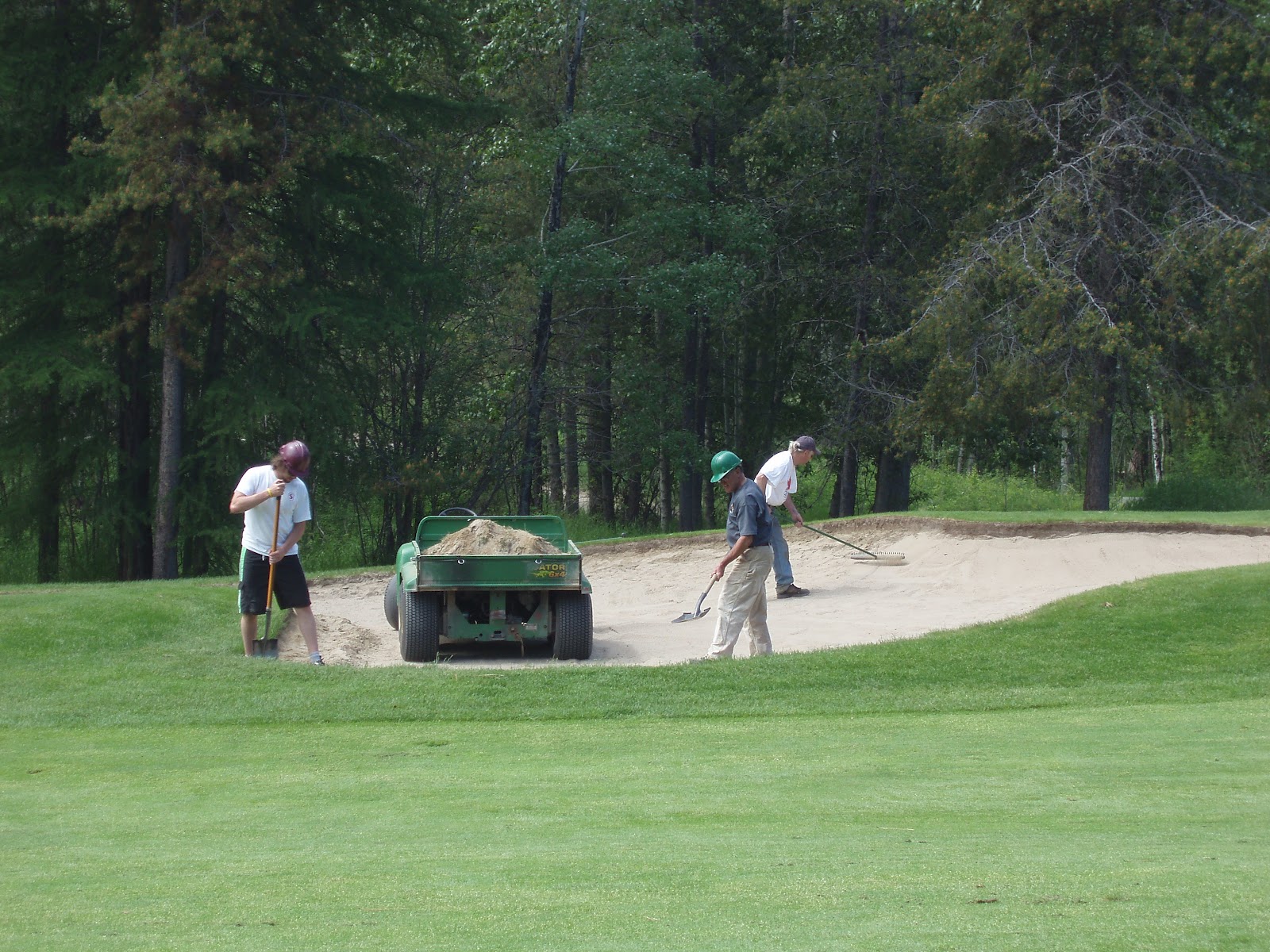 |
| Best Bunker Edgers I got |
Some other things we've done include fertilizing tee's. Although the process went well the result were brutal:
 |
| Sh*tty Fertilizer Application |
 |
| Fusarium |
Another ugly thing you may be seeing on the course relates to a type of winter damage I've yet to talk about.
 |
| Vole Damage |
 |
| Top Dressing the Vole Damage |
Other ugly things we are doing include expanding the mowing on certain tee decks. Picture says it all:
 |
| 4T "Expansion" |
 |
| Small, Little Seed Head Spots |

Friday, February 24, 2012
Picking at a scab...
Two weeks ago I went and pulled another plug from 9 green and was disappointed to be greeted with a smell that goes by many names, none of them good.
Although there was green to start with the smell indicated things were far from perfect.
Don't panic yet. I've been checking all over that green and the problem really seems isolated to back 30%. Yeah, there is ice over the entire surface but it is not as thick as it was at the back. Furthermore, the back of that green has a bit of a history of being troublesome. What I decided to do was experiment and see what happens. I have mentioned numerous times the risk of exposing Poa in the mid-winter but sometimes situations force you to make a choice. Any choices I make with respect to managing the ice on 9 will have a limited impact since the damage is done but, even though the area is small, I may be able to glean good "intel" that can be used in the future.
Poa under ice for greater than 45 days will not survive (so says certain research) and bent has over 100 days before it is impacted by ice cover (again, so says certain research). Research also suggests exposing Poa and even bentgrass too early can have a negative impact on the cold hardiness of both plant species. More research indicates that the development of low oxygen under ice will also severely impact turf health. So here's the thing we got ice and (based on smell) anoxic conditions under the ice, we got Poa annua under ice cover for close to 45 days, and we still got winter temperatures. It's sorta sounds like we are dammed if we do or dammed if we don't or in parlance of Star Trek this is a classic Kobayashi Maru !
I decided that, since the second plug we pulled from 9 green had definitely gone funky, we needed to address the anoxic conditions that existed to limit further damage to any remaining live turf (hoping against all hope that we have a secret stash of Bentgrass hiding within the turf canopy)
I used the skid steer to scrape down to the ice and then followed up by using the aerator to chip away at the ice. It took multiple passes with the aerator in numerous directions before I was able to get near the greens surface.

Now all we have to do is wait and see what happens. I did this with a close eye on the forecast. This time out I wasn't looking to melt the ice only increase air exchange. I think it is vital that any free moisture been avoided because of the problems associated with repetitive freezing and thawing. I did this on Thursday afternoon with the hope of limiting the turfs exposure to temperature swings. Fridays forecast was for seasonal temperatures with snow starting in the afternoon and as I write this I can confirm the weatherman was right on all counts!
 | |||
| 9G_Feb_17 |
 |
| 9G_Feb_21 |
Poa under ice for greater than 45 days will not survive (so says certain research) and bent has over 100 days before it is impacted by ice cover (again, so says certain research). Research also suggests exposing Poa and even bentgrass too early can have a negative impact on the cold hardiness of both plant species. More research indicates that the development of low oxygen under ice will also severely impact turf health. So here's the thing we got ice and (based on smell) anoxic conditions under the ice, we got Poa annua under ice cover for close to 45 days, and we still got winter temperatures. It's sorta sounds like we are dammed if we do or dammed if we don't or in parlance of Star Trek this is a classic Kobayashi Maru !
I decided that, since the second plug we pulled from 9 green had definitely gone funky, we needed to address the anoxic conditions that existed to limit further damage to any remaining live turf (hoping against all hope that we have a secret stash of Bentgrass hiding within the turf canopy)
 | ||
| Two pieces of equipment you never want to see on a green in the winter |
 |
| Initial pass with aerator only left small dimples |
It took one guy four hours to get most of the ice off. After seeing the conditon of the turf once the ice was removed I have a hunch that the most serious anoxia was in small pockets at the back of the green. Other areas I exposed appeared green and only had a slight sour smell and not the stinky barnyard smell.

Now all we have to do is wait and see what happens. I did this with a close eye on the forecast. This time out I wasn't looking to melt the ice only increase air exchange. I think it is vital that any free moisture been avoided because of the problems associated with repetitive freezing and thawing. I did this on Thursday afternoon with the hope of limiting the turfs exposure to temperature swings. Fridays forecast was for seasonal temperatures with snow starting in the afternoon and as I write this I can confirm the weatherman was right on all counts!
Sunday, January 8, 2012
What does Ice mean?
A Brief History of 9 Green
Ice Development
 |
| November 13 First snow |
 |
| December 29 End result after rain event and the on set of a cold snap. Earlier snow has begun to form ice on the surface |
 |
| January 4 More snow, more rain, and more cold. Poor insulation from shallow snow cover is causing ice to set up "tighter" |
 |
| January 8 Ice thick enough that you need a shovel to chip ice to loosen it.
Not an ideal start to 2012 but it may be time to start thinking of golf again. Since my last post in mid-December course conditions and the weather have been somewhat variable. We've had rain, snow, lows of -18 Celsius, and highs of +8 Celsius. Over that time the snow has gone through a few changes as demonstrated by the above pictures. So now what? First look at "Winter Kill" a post I did back in 2009 for a quick and dirty refresher.
Ice isn't always the harbinger of death but it makes for some stressful times. The ice we are seeing now is fairly set up over frozen turf and is no thicker than 1/2 to 3/4 of an inch. Because I feel the turf entered winter somewhat prepared (versus 2009) it is my hope that the only thing this ice really means is we won't damage the surface if we decide to blow snow.
At the risk of stereo typing Poa annua (the predominant grass species throughout the entire golf course), the one thing to keep in mind is Poa a nice lookin' grass but it's not very smart. Any sign of spring like weather and Poa will burn up it's stored winter carbs and start prancing around like it's mid-June. Without the "antifreeze" like protection the carbohydrates offer even a small drop in temperature below 0 degrees could result in damage from crown dehydration (FYI: intracellular crown dehydration is the sudden freezing of fluid within plant tissue that draws water from cells dehydrating them and killing the turf; extracellular cellular crown dehydration happens the same way but ice forms outside the turf plant). Truthfully, however, I am not 100% sure of what to expect so I'll keep checking the green surface to monitor the ice development and keep doing the "smell test" to get a feel for what may be happening.
|
Monday, April 4, 2011
Two Steps Forward, One Step Back
By the end of last week the snow was beginning to disappear at a slow and steady rate and some of the greens were becoming exposed and everything seemed good. Obviously, the past weekends weather has set things back a bit. Optimistically, we should be back to where we were by the end of this week. Possible problems might be increased incident of disease on those greens that were exposed, but I doubt it. Everything I could see last week had no obvious problems and I would guess the turf can handle at least one more bout of winter.
The one other thing that could be addressed here is the Poa/Bent difference, again. Possible metaphors you could use to describe the two types of turf might be The Tortoise and the Hare, or The Ant and the Grasshopper with Poa representing the Hare and/or Grasshopper. Throw in the fact that it doesn't take a whole lot of encouragement for Poa to "get its dormancy off" and what could result is an ill-timed growth spurt. Bentgrass, obviously, represents the other side of those fables: slow and steady, plan for a rainy day, etc. etc. is less likely break dormancy early. Breaking winter dormancy too early could lead to damage from crown hydration. Damage results when cells within the crowns (the point from which leaf and roots originate,again think of an onion) absorb water and freeze. If the temperature drop is severe ice may develop within the plants and burst the cells ultimately killing the plant. I have referenced this before as it relates to damage in the early winter and melting ice and is the biggest reason why I want surface water off the greens in the spring. I would hazard a guess that this is a slim possibility. If anything good came out of the snow this past weekend it was the protection the cover offered from the -12 lows experienced on Saturday night.
I'll keep everyone informed by posting where we are at later in the week.
I'll keep everyone informed by posting where we are at later in the week.
Monday, June 14, 2010
Poa in full "flower"

Seed Head produces by Poa
Tuesday, May 11, 2010
Green Measles
If you've been lucky enough to get golfing in between snow days last week you may have noticed green dots on some of the greens:

.

Those dots are indicative of the turfs response to aeration. Aeration will come up lots and there is always plenty to talk about but for now I wanted to show the obvious benefits of aerating greens. Everybody knows that plants leaves absorb carbon dioxide and release oxygen (photosynthesis) but sometimes people forget that the plants also need to absorb oxygen to make the energy (respiration) for cellular reactions occur. I am going to be fast and loose with the facts but a fairly "true" statement is all parts of the plant need to absorb oxygen in order for the plant to survive. Roots absorb oxygen to help fuel the transportation of nutrients into and throughout the plant. Some nutrition can be foliar absorbed but strong, healthy turf needs a strong, healthy, functioning root system. Each green dot seen in the first picture is the exact spot where an aerator tine penetrated the turf and left behind a open column down which water and air can travel. I used a cup cutter to "slice" through one of these columns to reveal the growth of roots over five inches deep on a mostly Poa annua green. If you look back to "Bent vs. Poa" post in February you can see pictures of Poa annua roots that are barely two inches. If you double click the following picture you can get a better look. Yeah, I know it is not a great picture but for this green, number 7, that is pretty impressive. You'll just have to take my word for it.

Friday, February 26, 2010
Bent Vs. Poa
Slowly winter is disappearing on the golf course. Traditionally, we would have 10-14 inches of snow. As of this week there is any where from 5-7 inches with lots of south facing slopes and areas around certain trees already exposed. We are keeping an eye on the surfaces and have not seen any more ice develop. The crusty layer referenced in January 23 post has actually lost some of its cohesiveness and is removed with very little effort.
I removed a plug from 9 green about 10 days ago from the back right (a cold shady corner). In the above picture the different colors are due to the mixture of bent grass and Poa. I pulled a core that had both grass species to compare how they would green up.
 The thing to note is the different tissue colors and the yellow on the left edge of the plug. It is subtle but the blue/green grass blades are Bent grass. The yellow and lime green grass blades are Poa. What this suggests is the Poa may be slow to get going this spring.
To survive the winter and start spring growth grass plants depend on carbohydrate reserves that are accumulated in the fall and stored in the roots. Poa has many good characteristics, however, deep rooting is not one. To explain this point I took plugs from 18 Green.
(A short history first: when we had ice damage in 2008 and had to sodded 18 green. We trenched in a drain from the low spot where ice develops to a catch basin off in the rough. Within the trench we installed a drain tile and a length of heat tape. Each fall we have to find the end of the drain tile we buried under the green so we can have a way to drain any water that may develop under the snow. In an effort to keep the playing surface consistent we sodded the ice damaged area with Poa except for a small chunk of Bent grass which is marking the end of the drain tile under the green surface.)
The following picture shows a Poa plug at the top and a bent plug at the bottom. The interesting part is underneath the surface. The following picture shows the root zone of the Poa plug that existed at the end of October in 2009; unfortunately, fairly typical for most greens.
  This next picture is the root zone of the bent grass plug
 There can be a number of different causes affecting root growth such as light availability, traffic, growing medium, fertility, soil structure and height of cut. What the two previous pictures demonstrate is the importance of grass species when it comes to root development. Remember, these two plugs were directly adjacent to one another so they would experience the exact same conditions. The only difference is one plug is bent the other Poa.
Going back to this spring: with such a small root mass, Poa is not very resilient to multiple stresses. As I mentioned in the December 12 post last falls weather played havoc with the fall preparations needed to help turf overwinter in best possible condition. The plug from 9 green maybe a forewarning of what exists on the rest of the greens. The most important thing now is to get the Poa growing without any extra stress like multiple freeze thaws, ill-timed temperature drops, or early traffic.
I removed a plug from 9 green about 10 days ago from the back right (a cold shady corner).
 In the above picture the different colors are due to the mixture of bent grass and Poa. I pulled a core that had both grass species to compare how they would green up.
 The thing to note is the different tissue colors and the yellow on the left edge of the plug. It is subtle but the blue/green grass blades are Bent grass. The yellow and lime green grass blades are Poa. What this suggests is the Poa may be slow to get going this spring.
To survive the winter and start spring growth grass plants depend on carbohydrate reserves that are accumulated in the fall and stored in the roots. Poa has many good characteristics, however, deep rooting is not one. To explain this point I took plugs from 18 Green.
(A short history first: when we had ice damage in 2008 and had to sodded 18 green. We trenched in a drain from the low spot where ice develops to a catch basin off in the rough.
 Within the trench we installed a drain tile and a length of heat tape. Each fall we have to find the end of the drain tile we buried under the green so we can have a way to drain any water that may develop under the snow. In an effort to keep the playing surface consistent we sodded the ice damaged area with Poa except for a small chunk of Bent grass which is marking the end of the drain tile under the green surface.)
 The following picture shows a Poa plug at the top and a bent plug at the bottom.
 The interesting part is underneath the surface. The following picture shows the root zone of the Poa plug that existed at the end of October in 2009; unfortunately, fairly typical for most greens.
  This next picture is the root zone of the bent grass plug
 There can be a number of different causes affecting root growth such as light availability, traffic, growing medium, fertility, soil structure and height of cut. What the two previous pictures demonstrate is the importance of grass species when it comes to root development. Remember, these two plugs were directly adjacent to one another so they would experience the exact same conditions. The only difference is one plug is bent the other Poa.
 Going back to this spring: with such a small root mass, Poa is not very resilient to multiple stresses. As I mentioned in the December 12 post last falls weather played havoc with the fall preparations needed to help turf overwinter in best possible condition. The plug from 9 green maybe a forewarning of what exists on the rest of the greens. The most important thing now is to get the Poa growing without any extra stress like multiple freeze thaws, ill-timed temperature drops, or early traffic.
Subscribe to:
Posts (Atom)