.....meaningful titles are sometimes hard to come by. Anyways, here's what's been happening over the past couple days. Last weekends forecast was pretty much on the nose regarding snow and cold. I went out on Sunday and put down the tarps and Enkamat before the weather hit but had to tweak the process a bit. Like I mentioned before, since we were unable to afford more Enkamat, I had planned to split it up amongst the greens that I think may need it the most. The new tarp for #15 green scared me because it is so 'impermeable-like" (remember anoixia? go HERE) so I used the Enkamat to cover close to 80% of the green to maintain an air gap before rolling out the new tarp. The remaining Enkamat was only able to cover a little less than 2/3's of #7 green (which is where the other impermeable tarp is located). So, obviously, the upper putting green, the back of #9 green and the lower tier of #6 green do not have any Enkamat. This is too bad since the condition of these surfaces in the spring were pretty good and I think that was partly due to the Enkamat.
The one unfortunate part with the arrival of winter at the beginning of the week was the wind that preceded the system. I staple the tarps to the ground and generally add extra on the side of any edge facing the prevailing wind. The wind last Sunday night was the dreaded "backwards wind" which meant it blew completely opposite to the way it normals comes. The end result was the semi-permeable tarp on #9 blew off. I've decided not to remove the snow from the green and expose it to all the predicted cold temperatures. I'll try to fix the tarp later.
I've mostly been inside during the mornings either reviewing expenses or looking into ideas I've had during the summer but didn't have time to investigate (for example, I think I've found a way to use my phones GPS and Google Maps to record and store in the "cloud" the fertilizer and/or chemical applications we make during the season. With that information we can be somewhat more accurate with our record keeping...something that may be a requirement in the ever changing "landscape" of pesticide regulations.) The rest of the day I continue to prepare equipment or areas of the golf course for winter.
One more thing. During the summer when I received positive comments about the condition of the course I would, at some point during the conversation, say something like "it's been a good year to grow grass" or something along that line. I wasn't trying to be modest but I was instead making an observation. An article written by an agronomist from the USGA Green Section comments on course conditions as they relate to weather. To be fair the article seems more to be referencing an apparent habit of players to equate good conditions with good weather while ignoring the importance of a superintendent and blaming the superintendent entirely for poor conditions while completely disregarding the impact of bad weather. Thankfully, to this point in time, that has never been a huge problem at this club for me. What I like about the article is the last two paragraphs which have a simple math equation that can be used to sum up course conditions in a succinct manner. Again, the gist of the article isn't overly applicable to our/my situation but it is some food for thought. Take a look HERE to read it.
Showing posts with label anoxia. Show all posts
Showing posts with label anoxia. Show all posts
Sunday, November 16, 2014
Wednesday, January 30, 2013
Rule of 1/3's
You could divide the off season in 1/3's. The first third starts once everything is put to bed and after the first substantial snow fall that is too much to reasonably remove, somewhere around 6-8". During that time you're on pins and needles praying for more snow and no rain. The middle third is now: full on winter. If there is any warmth during the day it very short lived. Hopefully, there is enough cover to withstand the dreaded mid-winter season "warm spell/rain event". The weather is generally cold and I am mostly inside. It's only me and, as anti-social as it sounds, I like it because there is very few distractions. The final third begins somewhere around mid-February. With the days getting longer and with some heat in the sun its not unusual to see some turf areas begin to open up. Also, if you have ice problems now is the time when you start to addressing them. Any earlier doesn't necessarily make sense based mostly on the short days, lack of warmth, and the potential for severe winter weather.
Along with the first 1/3 the final 1/3 is where, I feel, some of the greatest potential for turf damage can occur. Mostly this suspicion relates to damage caused by the development of ice (leading to anoxia: low oxygen) and its removal (possibly causing crown hydration: water taken up by the turf freezes and burst cells when temperature drops). But even without ice an early melt that saturates the surface followed by a severe temperature drop or sustain cold snap can also lead to damage (again, crown hydration). The one good thing about the final 1/3 of the season is you can usually address problems and somewhat lessen their severity since the weather in usually changing for the better.
Sometimes you get a season like we've had so far. The first 1/3 was not the best but we've had way worse. I suspect the biggest impact may be increased disease on those fairways that were sprayed early on for snow mould and saw a very large amount of rain on a treatment that doesn't like rain. Right now we are in the middle 1/3 and I feel sort of guilty since it has been an easy time with no obvious problems. We did get some ice as mentioned in a earlier post but as of yesterday it is still pretty loose and things look and smell "green". If the rest of the off season remains similar we could be coming through looking pretty good. Oops, I jinxed it, didn't I?
Along with the first 1/3 the final 1/3 is where, I feel, some of the greatest potential for turf damage can occur. Mostly this suspicion relates to damage caused by the development of ice (leading to anoxia: low oxygen) and its removal (possibly causing crown hydration: water taken up by the turf freezes and burst cells when temperature drops). But even without ice an early melt that saturates the surface followed by a severe temperature drop or sustain cold snap can also lead to damage (again, crown hydration). The one good thing about the final 1/3 of the season is you can usually address problems and somewhat lessen their severity since the weather in usually changing for the better.
Sometimes you get a season like we've had so far. The first 1/3 was not the best but we've had way worse. I suspect the biggest impact may be increased disease on those fairways that were sprayed early on for snow mould and saw a very large amount of rain on a treatment that doesn't like rain. Right now we are in the middle 1/3 and I feel sort of guilty since it has been an easy time with no obvious problems. We did get some ice as mentioned in a earlier post but as of yesterday it is still pretty loose and things look and smell "green". If the rest of the off season remains similar we could be coming through looking pretty good. Oops, I jinxed it, didn't I?

Wednesday, November 7, 2012
Winter Preparations
Just a post summing up where I am with respect to being ready for winter. This past week I applied the last treatment to the greens and finished the fairways as well as installed all the posts for the fencing around select greens. Generally speaking the greens are entering the winter in good condition with #7 being the worst since it never really grew out the fall disease and seems to have developed more over the past few weeks. Since the last spray was completed we will now put up fences (too late for some greens) and start in on tarping.
A refresher on tarps is here if you are so inclined otherwise read on. The two impermeables are out and ready to be deployed but I'm waiting for more winter like weather. The semi-permeables are on #1, #6, #7, #9 and #12. I threw 9 and 12 into the mix because of how they overwintered this past year and the hope is the extra coverage may help limit damage if they become exposed or if ice develops (I've had some success removing ice from the semi-permeables quicker than from a greens surface in the past).
Tarps aren't my favorite because they introduce another variable in the overwintering of greens which can be negative. You heard me talk of anoxia (low oxygen) in regards to both ice and tarps. Obviously, if there is thick ice tarps help remove the ice but don't do anything in the case of anoxia which can occur because of ice or because of impermeable tarps - go here for a history. Anoxia is sort of hit and miss when it comes to tarps, and luckily we've been in a mostly miss situation. However, this year I am experimenting with a product that could help.
Enkamat is really an erosion control mat but it is also being marketed as "a three-dimensional lofty matrix that provides a protective layer over
vulnerable turf. Enkamat prevents the formation of an ice layer over
greens that can seal turf, and prevent gas and oxygen exchange that is
vital to turf health". I plan to use the "lofty matrix" trait to provide an air layer under a section of the impermeable tarp on 7 green. I'll be comparing it with our usual covering system on 7 green (green covered with semi-perm. covered with imperm.) along with just the impermeable directly on the surface. That all sounds awkward so take a look:
I will cover this whole mish-mash with the impermeable and see if the Enkamat is benefit or no different than what we normally do. I also plan to lay the mat on back of 9 green surface by itself where ice has been a problem to see what the product can do if ice again develops there. Further, I will put a strip on top of the tarp on 15 green where we always get ice no matter what and see if, when the time comes, does the mat speed the ice removal or not. One more thing I plan to do is cover the entire top end of the new putting green that was hammered this spring to see what will happen....which can't be much worse that what happened this spring!
A refresher on tarps is here if you are so inclined otherwise read on. The two impermeables are out and ready to be deployed but I'm waiting for more winter like weather. The semi-permeables are on #1, #6, #7, #9 and #12. I threw 9 and 12 into the mix because of how they overwintered this past year and the hope is the extra coverage may help limit damage if they become exposed or if ice develops (I've had some success removing ice from the semi-permeables quicker than from a greens surface in the past).
Tarps aren't my favorite because they introduce another variable in the overwintering of greens which can be negative. You heard me talk of anoxia (low oxygen) in regards to both ice and tarps. Obviously, if there is thick ice tarps help remove the ice but don't do anything in the case of anoxia which can occur because of ice or because of impermeable tarps - go here for a history. Anoxia is sort of hit and miss when it comes to tarps, and luckily we've been in a mostly miss situation. However, this year I am experimenting with a product that could help.
 |
| Enkamat |
 |
| Layout of Tarps Under Impermeable |
Thursday, June 7, 2012
Trying to Figure it Out
It's probably the farthest thing from your mind but this post is a review of winter damage we experienced this year. One thing I am learning is just as it takes multiple inputs to make the turf appear good it also takes more than one thing to cause damage. I am always looking for common denominators to explain damage. It's only with the benefit of hindsight do I think that one of the factors impacting spring conditions was the level and condition of the snow cover on the greens this past winter. All the areas damaged this spring were prone to poor snow coverage during one or multiple times through out this past winter.
What about the wrinkles of green under the tarp on #1 green? This was where the semi-permeable tarp created insulating air gaps between the turf and the ice (a case for insulating greens prone to early season melting, i.e. bubble wrap).
What really got me thinking about this was comparing the snow pack (depth and consistency) between 12 and 13 greens. In late February there was 8" of tight corn snow on 12 green over a 1/2 of surface ice. On that same date 380 yards away on 13 (a green with the same aspect) there was 16" of loose corn snow over an ice free and thawed surface. Why? Both are surrounded on the left and back by trees but the trees on 13 are much farther away so, it is my theory, that the trees influence (in this case shelter from snow) was limited; i.e. less shelter from the trees on 13 so more snow on that green versus 12.
The damage on the front left of 1 green, I think, was caused by the trees acting as a heat sink. During sunny days they would absorbed heat and radiated it at night. Stupid sounding I know but I've been around enough times to see the snow melt first on the south west side of these trees to know that it is a very common occurrence. This happened a few times early in the spring and combined with the snow events we experienced in March I think that area went through a series of melts that created a number of freeze/thaw cycles that ultimately killed the turf.
 |
| Front Left #1 Green |
Now the putting green.
It too is prone to early season melting and freeze/thaw exposure. I've never worried about it because of the bent grass component. This time out I think the green was unhealthy going into winter and did not have the CHO reserves to cope with the freeze/thaw and ultimate anoxia created from the ice layer that developed. For this green it was probably that one-two punch that caused all the problems since the lower half, which was completely playable early on, had the same lack of fertility but no ice.
 | |
| New Putting Ice Layer |
What about 9 green? Remember this?
I exposed it thinking the damage was done so what could I lose? Interestingly enough while the back has mostly recovered it is those area on the right side that I did not touch in February that are still slow to come.
Probably that damage relates to the melting of the snow I did in early March. During that time the temperatures ranged from -14 to +10 and I think the mistake lies in melting the snow too fast (creating free water) and too early. At the time I was concerned with a slow melt and freeze/thaw damage. It may have been better to blow what snow I could, melt any ice and then tarp the green.
 |
| Ice Removed From Back #9 Green |
 |
| #9 Green One Day After Black Sand Melted Snow |
All these areas struggle with shade during the spring and fall but so do other greens and they weren't damaged. But, again I think, a possible common denominator is the condition of the snow cover. Most all other greens had a deep snow pack and were slow to melt. The real kicker for me is the damage on 12 green. The worst area is the spot where I exposed it very early thinking I was limiting the ice damage. The rest of the green that I left covered was still damaged but has recovered faster than that back tier that was exposed earlier -- opposite as to what has occurred on #9 green.
Next winter it will be a different story. I know this is long winded and awkward and maybe I've over explained stuff but I think with the way this spring has shaped up for golf courses in this area people should know that the choices made when dealing with winter can have different results within a golf property let alone different results between golf properties.
Next winter it will be a different story. I know this is long winded and awkward and maybe I've over explained stuff but I think with the way this spring has shaped up for golf courses in this area people should know that the choices made when dealing with winter can have different results within a golf property let alone different results between golf properties.
Friday, February 24, 2012
Picking at a scab...
Two weeks ago I went and pulled another plug from 9 green and was disappointed to be greeted with a smell that goes by many names, none of them good.
Although there was green to start with the smell indicated things were far from perfect.
Don't panic yet. I've been checking all over that green and the problem really seems isolated to back 30%. Yeah, there is ice over the entire surface but it is not as thick as it was at the back. Furthermore, the back of that green has a bit of a history of being troublesome. What I decided to do was experiment and see what happens. I have mentioned numerous times the risk of exposing Poa in the mid-winter but sometimes situations force you to make a choice. Any choices I make with respect to managing the ice on 9 will have a limited impact since the damage is done but, even though the area is small, I may be able to glean good "intel" that can be used in the future.
Poa under ice for greater than 45 days will not survive (so says certain research) and bent has over 100 days before it is impacted by ice cover (again, so says certain research). Research also suggests exposing Poa and even bentgrass too early can have a negative impact on the cold hardiness of both plant species. More research indicates that the development of low oxygen under ice will also severely impact turf health. So here's the thing we got ice and (based on smell) anoxic conditions under the ice, we got Poa annua under ice cover for close to 45 days, and we still got winter temperatures. It's sorta sounds like we are dammed if we do or dammed if we don't or in parlance of Star Trek this is a classic Kobayashi Maru !
I decided that, since the second plug we pulled from 9 green had definitely gone funky, we needed to address the anoxic conditions that existed to limit further damage to any remaining live turf (hoping against all hope that we have a secret stash of Bentgrass hiding within the turf canopy)
I used the skid steer to scrape down to the ice and then followed up by using the aerator to chip away at the ice. It took multiple passes with the aerator in numerous directions before I was able to get near the greens surface.

Now all we have to do is wait and see what happens. I did this with a close eye on the forecast. This time out I wasn't looking to melt the ice only increase air exchange. I think it is vital that any free moisture been avoided because of the problems associated with repetitive freezing and thawing. I did this on Thursday afternoon with the hope of limiting the turfs exposure to temperature swings. Fridays forecast was for seasonal temperatures with snow starting in the afternoon and as I write this I can confirm the weatherman was right on all counts!
 | |||
| 9G_Feb_17 |
 |
| 9G_Feb_21 |
Poa under ice for greater than 45 days will not survive (so says certain research) and bent has over 100 days before it is impacted by ice cover (again, so says certain research). Research also suggests exposing Poa and even bentgrass too early can have a negative impact on the cold hardiness of both plant species. More research indicates that the development of low oxygen under ice will also severely impact turf health. So here's the thing we got ice and (based on smell) anoxic conditions under the ice, we got Poa annua under ice cover for close to 45 days, and we still got winter temperatures. It's sorta sounds like we are dammed if we do or dammed if we don't or in parlance of Star Trek this is a classic Kobayashi Maru !
I decided that, since the second plug we pulled from 9 green had definitely gone funky, we needed to address the anoxic conditions that existed to limit further damage to any remaining live turf (hoping against all hope that we have a secret stash of Bentgrass hiding within the turf canopy)
 | ||
| Two pieces of equipment you never want to see on a green in the winter |
 |
| Initial pass with aerator only left small dimples |
It took one guy four hours to get most of the ice off. After seeing the conditon of the turf once the ice was removed I have a hunch that the most serious anoxia was in small pockets at the back of the green. Other areas I exposed appeared green and only had a slight sour smell and not the stinky barnyard smell.

Now all we have to do is wait and see what happens. I did this with a close eye on the forecast. This time out I wasn't looking to melt the ice only increase air exchange. I think it is vital that any free moisture been avoided because of the problems associated with repetitive freezing and thawing. I did this on Thursday afternoon with the hope of limiting the turfs exposure to temperature swings. Fridays forecast was for seasonal temperatures with snow starting in the afternoon and as I write this I can confirm the weatherman was right on all counts!
Monday, March 28, 2011
Blowin' Snow
The snow level is starting to drop to a manageable level for us to work with. Shady spots still have up to 16 to 18 inches but other areas with even a little mid-day sun are getting down to the 12" level.

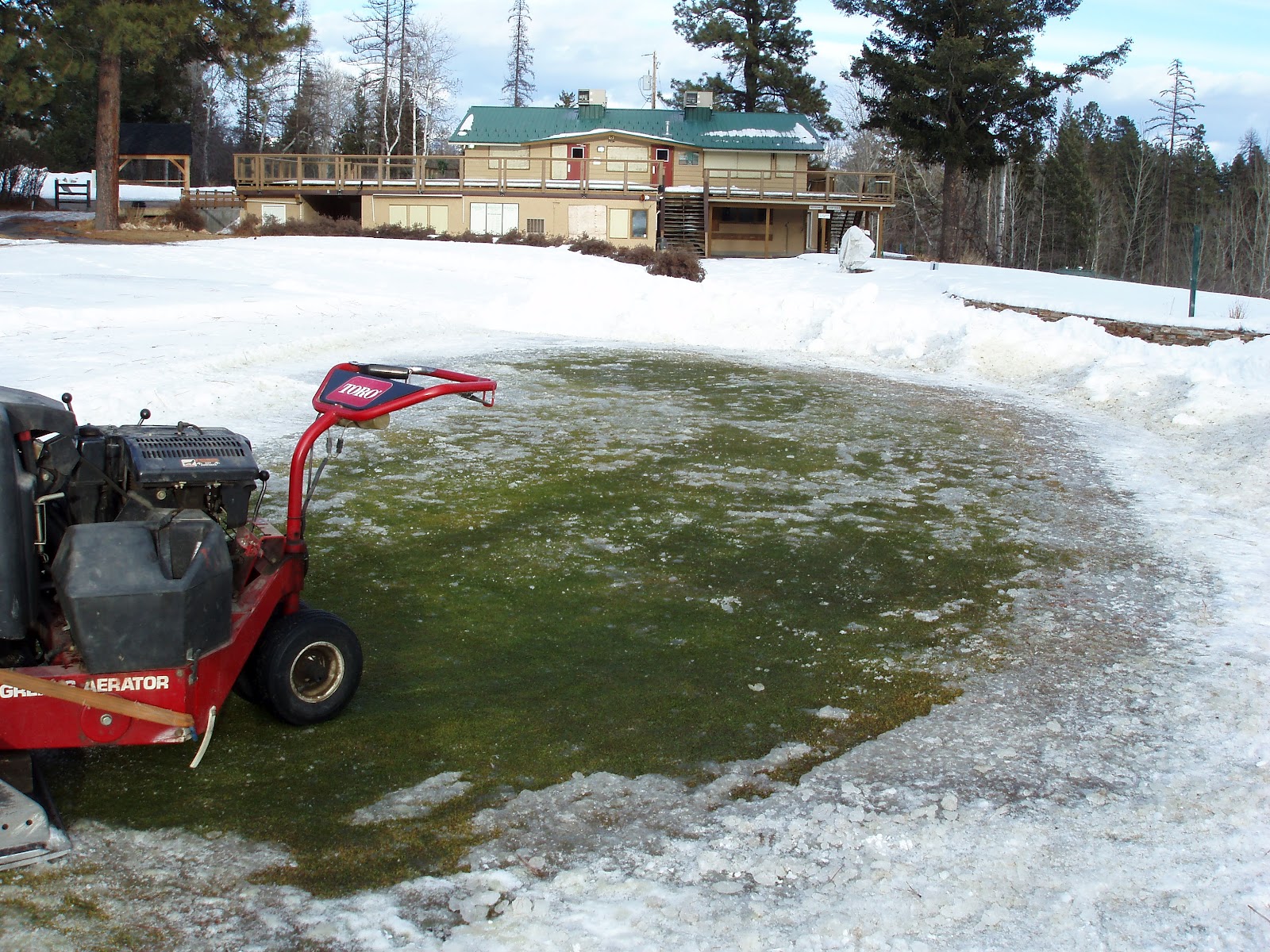
We began removing snow from the greens and started with #7 since it was the only green with an impermeable cover. We wanted to get some air exchange between the stale air under the tarp and the atmosphere (this relates back to a condition called anoxia. See http://kimberleygolfclub.blogspot.com/2009_11_01_archive.html). Things appear to be O.K. with no obvious disease and no stench (the usual indicator of problems). As usual, we will get a better read on things once the turf shows signs of growth.
Monday, November 23, 2009
Snow and Tarping Greens
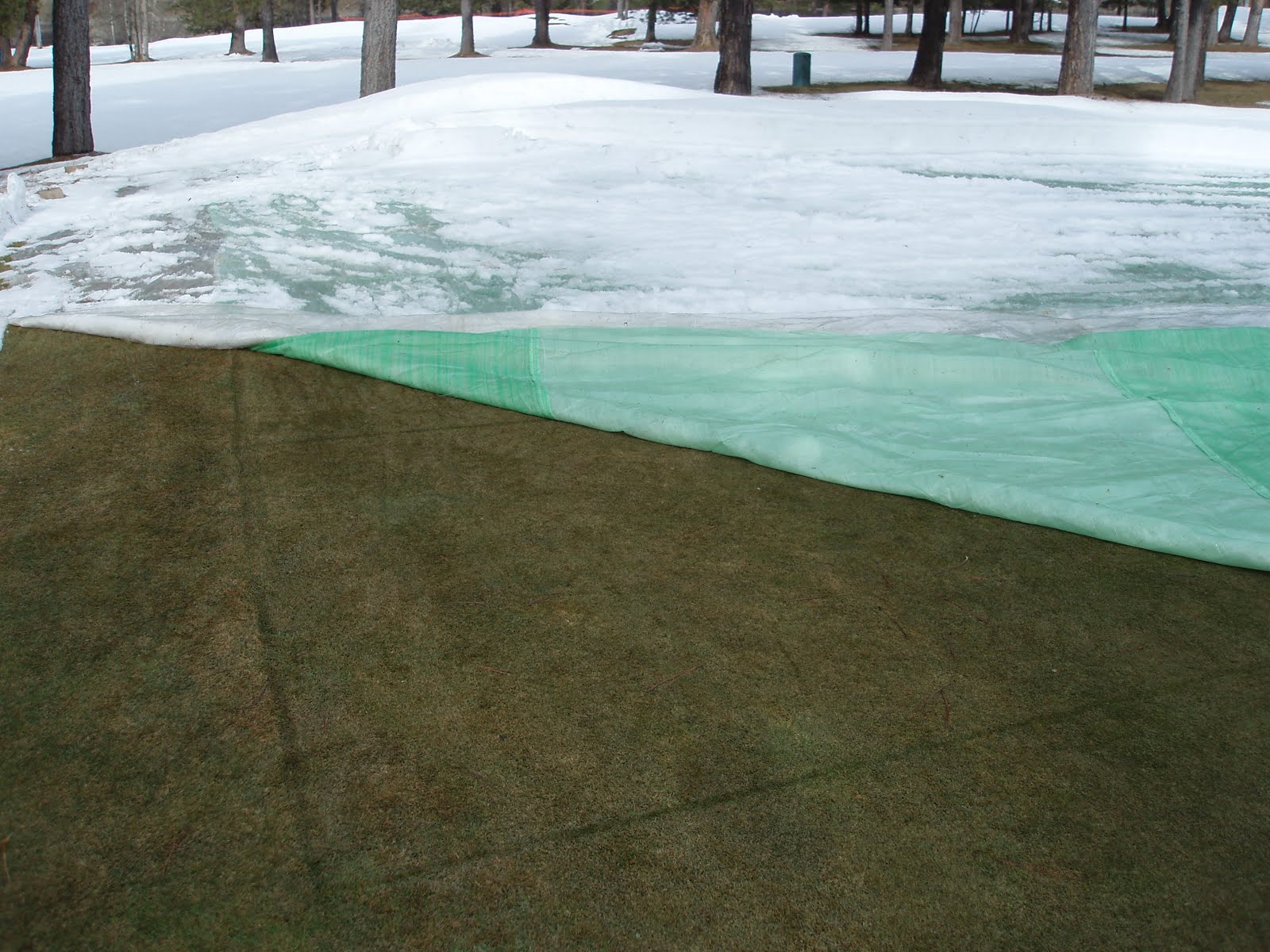
With winter looking a little more possible we began to wrap up some loose ends on the golf course. The only real significant thing left was to tarp the greens that are prone to ice damage. First we had to shovel off the skiff of snow that had stuck around before laying down the tarps. Unlike previous years, we left those greens we tarp exposed a bit longer so the ground could freeze. Some information coming out of Alberta suggests laying a tarp before the ground freezes may contribute to a condition called anoxia (lack of oxygen). Up until the spring of 2007 when #6 green was damaged we have never experienced any damage due to covering the greens.
  The picture above shows the damage from that year which was similar in appearance to greens at other golf courses that were discovered to have anoxic conditions during the winter of 2006. This year we've changed the style of tarp from an impermeable to a tarp with a looser weave that should allow gas exchange but limit water penetration. At present, we have around 2 to 3.5 inches snow throughout the course. This is still not enough to buffer any significant rain event. We will keep an eye on the forecast and try to make the right choices if it looks like rain. I'll keep snow and course conditions updated over the next few weeks but unless things get funky the entries will be short and sweet.
 Unlike previous years, we left those greens we tarp exposed a bit longer so the ground could freeze. Some information coming out of Alberta suggests laying a tarp before the ground freezes may contribute to a condition called anoxia (lack of oxygen). Up until the spring of 2007 when #6 green was damaged we have never experienced any damage due to covering the greens.
  The picture above shows the damage from that year which was similar in appearance to greens at other golf courses that were discovered to have anoxic conditions during the winter of 2006. This year we've changed the style of tarp from an impermeable to a tarp with a looser weave that should allow gas exchange but limit water penetration. At present, we have around 2 to 3.5 inches snow throughout the course. This is still not enough to buffer any significant rain event. We will keep an eye on the forecast and try to make the right choices if it looks like rain. I'll keep snow and course conditions updated over the next few weeks but unless things get funky the entries will be short and sweet.
Subscribe to:
Posts (Atom)