Showing posts with label winter kill. Show all posts

Tuesday, March 8, 2016

Not Exactly Routine

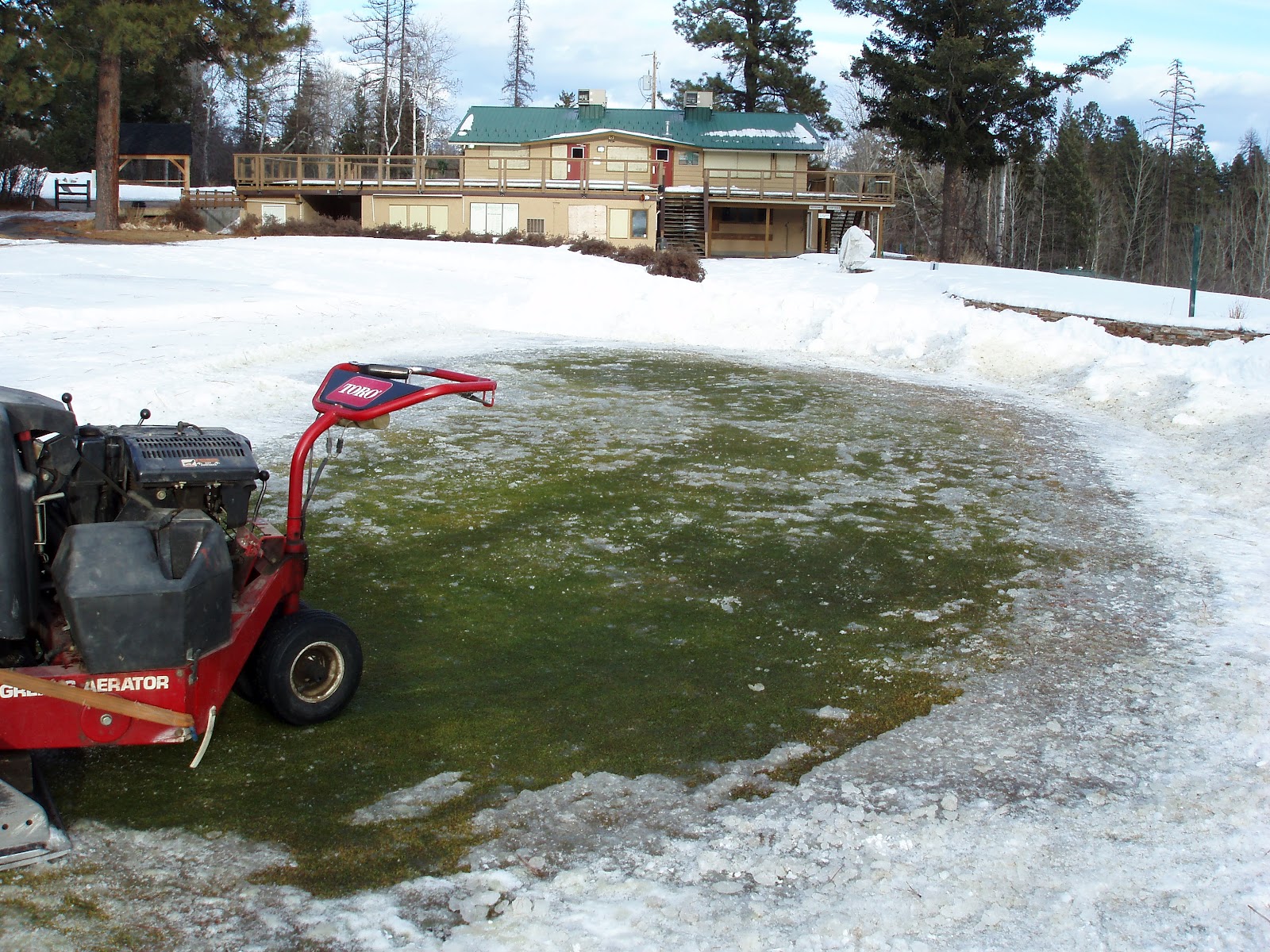
Previous to last week I was trying to get a few unusual tasks out of my hair so I could focus on more traditional spring maintenance. With winter winding down we needed to get a pumper truck and rubber tire back hoe out on the course before the ground got too soft from all the melting snow. Back in the beginning of February I ploughed a road to the restroom on #7 as well as to the snack shack. With the ground being unfrozen under the snow this year I needed to expose areas so they could freeze and handle the weight of the equipment I needed to bring on the golf course

Driver weaving the "Honey Wagon" through the trees

All restrooms located on the golf course are on septic and of the 3 tanks only one had been pumped in my time there.

Sucking out the tank
During the process we discovered a problem in one of the tanks.  A root ball had grown inside the tank at the snack shack and had broken off.  Potentially, the "floater" could plug the inlet or discharge side of the tank so we made the choice to dig up the septic tank lid and remove the root ball (it was too big to fit through the access port).

Betcha' didn't know that is where the septic is!
Goo and Root
Removing root ball...carefully!
The snow was too deep to get to #12 but with cart paths on either side of that particular restroom we should be able pump out that septic most any time.  That same week we began limbing the tree that blew over on 6 fwy and I cut off the root ball had a back hoe come in and haul it off the course.
Knocking of excess before hauling it away

By the end of week we'd finished most of the bull work with minimal disruption from either the pumper truck or either back hoes and I began to remove snow off #7 and #15 greens. I needed to knock down the snow on #15 with black sand to make removing the snow more manageable. It's still a work in progress but I was able to clear #7 and remove the tarp. Much to my dismay there was disease under tarp, again! It's no where near as bad as last year but it's far from perfect. The worst part is as I began to see other greens open up I saw more signs of disease so I've spent the last 5 days removing snow from all greens in a hope to lessen the severity of the disease. I'll keep you informed once I get all greens cleared and things dry out.

Thursday, April 9, 2015

One for the Record Books

A rambling justification (?) for conditions this spring.  You'll need oodles of time to read all of this one.  Skip to the last paragraph for the "Coles Notes" version if you're pressed for time.

April 4th is one of the earliest opening we've had in a while.  Believe it or not but one of my many fantasies is to have the golf course and ski hill open at the same time: golf in the a.m. ski slush in the p.m.  I secretly strive towards this every year but seldom does it work (I make it work by hiking the hill but riding the chair is always a better option!).  Despite the fact that all irrigation is working, there's no snow, and its mostly dry out there we've only been able to get 10 holes ready for play.  Without more staff and time there was no way I was going to get more holes ready for play.

Working out on the course by myself last week gave me lots of opportunity to think.  I've been attempting to diagnose the damage on the greens and have come up with a number of reasons why, I feel, the disease was so extensive this year:

  1. The day I sprayed I choose not to bring in any staff to help out.  That day I had to remove all the tarps (only 6 tarps), take down the fences to give me access (only 7 fences), blow all the debris (leaves, needles, poop) off the green surfaces, spray all 20 greens, and clean up and put it all away.  At that time of year there is 9.5 hours of daylight.  The low was -4 and there was frost so I had to wait to get going but the point is there wasn't much time to do it all.  Furthermore, the later in the day the spray was applied the longer it took to dry, especially that time of year.  The following day, November 6th, I recorded showers throughout the day. 
  2. I've always called that November spray my "panic spray" since I always felt that I had enough chemical to carry me through the winter and all the last spray did was make me feel less panicky.  I've always left areas on certain greens and sometimes entire greens prone to disease as benchmarks to see if I really needed to apply the "panic spray" and it always appeared to be unwarranted since disease was never a problem on those benchmark areas.  That attitude clouded my decision process when it came to choosing what rate (i.e. amount) of chemical to use.
  3. Part of applying products with a sprayer involves not only calculating the amount of product required based on the area being sprayed and disease your attempting to control (the rate, again) but it is also necessary to apply the spray using the correct volume of water.  Water volume is dictated by the size of the spray nozzles.  For most fungicides sprayed at KGC the suggested water volume is anywhere from 8 to 40 L per 100 square meter.  With the minimum 8L volume I would need around 825 L to spray all the greens.  The tank on our sprayer is only 660 L so it takes one full tank plus a partial second tank.  As a result of reasons 1 and 2 (too little time, too little appreciation for importance of the "panic spray") I used a nozzle size that would ensure only one spray tank was needed to spray all 20 greens.
  4. Poor machine maintenance.  Last year at KGC was a harried year mechanic wise; we went through two.  By the time September rolled around we only had a part time mechanic who was only available to work when he had time after his regular full time day job.  At one point during my last spray (of course) a suction line that had obviously being wearing for awhile developed a small puncture.  A hole in the suction line introduces air into the system and the spray volume is affected.  A low spray volume because of small nozzles was made even less/worse because of the hole.
  5. Tarps and Enkamat 
Tying all these point together requires a long winded theory.  I've sprayed greens enough times with my regular nozzles (11003's for fertilizer and 11008's for pesticides) that I know where I should be based on any water volume appearing in the spray tank.  That knowledge makes it easy for me to catch any problems with the output at any point during the spray.  The nozzles I chose to use on my last tank were 11006's (I use these during fungicide applications on fairways).  I filled the tank with the required volume based on the area I was to spray.  I then decided to spray the surface of the greens in a circular fashion versus up and down to limit overlap into the apron and collar and possibly "waste" spray and risk running out before all the greens were treated.   After spraying the greens there was still a volume of solution left in the tank and because I used a different nozzle and sprayed the greens in a different direction I wasn't overly concerned.  I assumed I was able to stretch out the tank like I hoped I would.  After completing the spray I cleaned out the tank and the next day began taking it apart for storage.  Flash forward to last week.  With all the disease popping up I was worried and felt it would be prudent to do a spray in an attempt to lessen the disease impact.  Normally, before each spray I calibrate the sprayer to set the correct pressure (psi) to provide the necessary output but this spring I couldn't get the correct volume no matter what I tried.  Following the basic trouble shooting guidelines I discovered the problem with the suction line.  I confirmed it by borrowing a suction hose from another golf course and was able to achieve correct operating psi.  With regards to my last spray in November, I calibrated the sprayer before adding chemical so I know I didn't have a problem when I set out to spray.  At one point the suction line wore through and impacted the output volume (you'd think it would be obvious to see a hole in the suction line but it is a large rubber, braided line and even after confirming the suction line was the problem I couldn't see a hole.  I assume the hole was somewhere within the section of hose that had wear marks).  It took until the next time I calibrated the spray tank, i.e. this spring, to see the problem.  My record keeping is O.K. but what I didn't do, and I have done it in the past, was write down the order in which I sprayed greens.  During the regular season I spray in numerical order only to stay ahead of play.  That is not the most efficient way spray since more time is spent traveling versus spraying a green when you come to it regardless of the order.  I need bread crumbs to find my way home everyday so there is no way I remember what order I sprayed the greens last November.  I have a hunch though.  Knowing myself I know I would have started on #3, then gone to #1, #2, #4, #5 but after that who knows.  I probably would have gone to the back and try to finish somewhere on the front close to the shop in case I ran out.  I did record the observation that there was active Fusarium on certain greens (particularly 6 and 14) but nothing regarding the order of greens sprayed.  The reason I'm hung up the spray order is the level of disease appearing on those greens that were tarped.  By far those were the worse greens.  More than a few times during the late winter there was free water; not ice, not frost but actual water saturating the surfaces.  In most cases the surfaces thawed just enough to soak the top inch.  Had things not thawed a bit there would have been ice as seen in this picture:
Ice from Water under Tarp on 7G, Back Left Corner
Back to the order.  If the leaky suction line dramatically affected the sprayer output there should be an obvious point at which the output was reduce there by impacting the spray.  Had I recorded the spray order it would have helped.  The problem is the tarped greens really mess things up.  Greens that I know were sprayed early (such as #1 Green) had far more disease than is normally the case after a typical winter.  Obviously, this year the tarps created an environment that was conducive for disease development.  Truthfully, I've always been concerned of such an eventuality but in the past the sprays helped the situation.

Basically, you can sum up our problems by suggesting that limited staffing, lack of appreciation for the importance of the "panic" spray, poor equipment maintenance, and creating conditions that encourage the occurrence of disease all played a part in this springs conditions.  Like I said in the last post, there won't be a single cause explaining the problems this winter but more likely a combination.  I haven't even touched on a couple other thoughts banging around inside my head that relate to plant nutrition (I used 4.4 Kg/100 sqm less potassium in 2014 versus other years) as well as certain cultural practices (we've completely fell off the verti-cut routine plus we are using smaller tines during aeration and aerating less; both of those practices remove thatch which is were snow mould spores hide until conditions are right for germination).  The one common factor regarding the level of damage from disease is all the greens showing winter disease damage are the ones most prone to severe Fusarium during the spring and fall.  Greens such as 1, 2, 6, 7, 9, 12, 14, and 15 typically show more disease activity sooner than the other greens.  Again, this is probably the result of an interaction of number of circumstances and bit by bit I may figure it out but until that time the greens that were hit hard with disease this past winter will need lots of TLC.

Sunday, March 29, 2015

.....Out Like a "?" and a Crisis of Faith

Just days away until March is finished and up until today the weather has been very nice but the long range forecast is looking like the weather will be closer to "normal" for this area.  On the course, all the snow has melted with most disappearing at the beginning of last week. With the snow gone the soil started to warm and turf began to green up last Sunday.  It looks like I will have to bring staff in early since everything is starting to need attention and one guy cannot do it all.   It's March and already my wage budget is on very shaky ground.

Based on the religious undertones of the title of this post you'd think I was a church going guy but really its more a reflection of the struggle I've been having on the course this spring.  As I suggested in early posts, ice was not issue anywhere on the course.  Ice is that dark nemesis that is overwhelming and hard to control especially when there is unseasonably warm temperatures or rain in the middle of winter.  Too many times I've attempted to "manage" ice by physically removing it as it appears during the winter (Go HERE) or manipulating conditions to limit its formation:

Left Side was Tarped, Right Side was not.
but in the past the only real success I've had is waiting until the sun is high enough and days are long enough to get a strong melt.  This year disease was a problem; particularly pink snow mould:

#7 Green
This is our #1 disease and is a problem pretty much all year long but during the golf season I refer to it as Fusarium (the different names came about because of how and when the disease appears on the turf  but a taxonomic trait that relates to the types of spores the fungus forms and how they grow means, despite the different appearance, the disease is caused by the same fungus.  Sometimes in an effort to lessen the confusion in areas of the world that don't get snow the disease can be called Microdochium patch).  I know you've all seen it and may not have know what is was.  Generally, all  cool season turf is susceptible to this disease but bentgrass has levels of resistance bred into it, especially the newer varieties made popular over the past decade or so.  By now you know, because of our age, the predominant species of turf at KGC is poa which, again for those with a short memory, is an opportunistic weed and has no resistance to any disease bred into it.  In areas where I didn't apply a plant protectant (i.e. a fungicide which, BTW, is a pesticide) you get this:

#2 Fwy, Double Whammy Shade and No Spray

#12 Fwy at 200 yards

#14 Fwy @ 300 yards
Unlike the damage caused by ice, the only good thing about most diseases is I can manage them by implementing certain cultural methods (increasing the HOC, limiting irrigation, increasing sun exposure, increasing air movement, applying certain fertilizers, etc., etc.)  to lessen the severity.  Also, I can spray preventative and, sometimes, curative plant protectants (fungicides/pesticides) that are very effective at controlling the diseases they are labeled for.  If you look back at the previous pictures you'll notice the green, healthy looking turf.  Those are areas I sprayed to prevent damage from snow mould.  I can say that the level of control demonstrated on fairway and tees as a result of last falls snow mould treatments are equal to other years which means those areas are looking pretty good.  However, the level of control on the greens was the worst I seen in years and I'm having a real struggle coming up with a reason why.  I can also say with some degree of confidence that it is not due to one thing.  That would be an over simplification of a complex interaction of numerous variables that all impact the health of turf on any one of the greens at KGC.

That's enough for now.  I am looking at the possible reasons for the problems experienced so far this spring but I won't have a single, definitive cause; it doesn't work that way.

Friday, November 22, 2013

My Vote for an Eleven Month Calendar...

November, Ugh!  I lamented about this month last year and nothings changed.  It's not like I can go away and come back and completely miss it either since I have to be here to "manage" any situation that may develop.  But even in that regard I feel slightly neutered because I am really at the mercy of the weather.

All but two of the greens (#14 and #11) have lost their snow cover and the front nine fairways are basically without snow.  I decided to spray the exposed greens one more time since they did see a fair amount of moisture (8mm rain, 12 cm snow that melted, 3 cm snow that melted, 11 mm rain) as well as being exposed to mild temperatures and sun light -- all factors which act to affect fungicide efficacy.  As usual, I left areas untreated to see if the spray was warranted but I'll have to wait until spring to see.

The last couple days have seen lows of -18 Celsius and high of only -12.  Obviously with those temperatures combined with moisture at the beginning of the week the ground is setting up like concrete.  Not a bad thing disease wise but not a good thing if we get any rain since we would be guaranteed ice.  I've talked about winter damage to turf before but if you are interested you could go HERE for a quick read / refresher.

Cold temperatures are keeping me inside compiling numbers, reviewing, and planning.  The planning part is kind of a drag since next year will be status quo but the looking back at staff hours and fuel usage is interesting and lets me know if any of my goofy ideas worked out and where I can still make changes.  I keep threatening to talk about KGC's "maintenance metrics" so maybe if things stay the same I'll do that next time out.

Wednesday, January 30, 2013

Rule of 1/3's

You could divide the off season in 1/3's.  The first third starts once everything is put to bed and after the first substantial snow fall that is too much to reasonably remove, somewhere around 6-8".  During that time you're on pins and needles praying for more snow and no rain.  The middle third is now: full on winter.  If there is any warmth during the day it very short lived.  Hopefully, there is enough cover to withstand the dreaded mid-winter season "warm spell/rain event".  The weather is generally cold and I am mostly inside.  It's only me and, as anti-social as it sounds, I like it because there is very few distractions.  The final third begins somewhere around mid-February.  With the days getting longer and with some heat in the sun its not unusual to see some turf areas begin to open up.  Also, if you have ice problems now is the time when you start to addressing them.  Any earlier doesn't necessarily make sense based mostly on the short days, lack of warmth, and the potential for severe winter weather. 

Along with the first 1/3 the final 1/3 is where, I feel, some of the greatest potential for turf damage can occur.  Mostly this suspicion relates to damage caused by the development of ice (leading to anoxia: low oxygen) and its removal (possibly causing crown hydration: water taken up by the turf freezes and burst cells when temperature drops).  But even without ice an early melt that saturates the surface followed by a severe temperature drop or sustain cold snap can also lead to damage (again, crown hydration).  The one good thing about the final 1/3 of the season is you can usually address problems and somewhat lessen their severity since the weather in usually changing for the better.

Sometimes you get a season like we've had so far.  The first 1/3 was not the best but we've had way worse.  I suspect the biggest impact may be increased disease on those fairways that were sprayed early on for snow mould and saw a very large amount of rain on a treatment that doesn't like rain.  Right now we are in the middle 1/3 and I feel sort of guilty since it has been an easy time with no obvious problems.  We did get some ice as mentioned in a earlier post but as of yesterday it is still pretty loose and things look and smell "green".  If the rest of the off season remains similar we could be coming through looking pretty good.  Oops, I jinxed it, didn't I?

Sunday, September 30, 2012

October 1st and Time To Panic

What a farce.  The past month monkeying with the river has been a complete disaster.  I was concerned with government delays but instead it has been everything else that has dragged out the process.  Contractors, pumper trucks, and deliveries all seemed to conspire against us but really it was just a series of poorly timed events that includes the continuation of summer that have delayed the projects completion.

Everyday I go and see more areas succumbing to heat stress brought on by the lack of water and it is finally worrying me. As the season progresses to mid-fall and the days get shorter and colder the opportunity turf will have to green up and store carbs before the ground freezes are all but disappearing.  I am concerned with the wear on areas from traffic that are no longer growing.  There is no way they had sufficient time to prepare for a hard winter and I don't see how those areas will recover next year to the same condition they were in early on.

When we spray fungicide it has a systemic component that has to taken up by a living grass plant in order to work at its best.  That will not happen on any area that has already gone brown and dormant.  I guess if you had to put a positive spin on it you could say that disease also needs a live plant to wreak its havoc so why worry?  You worry because if we have a hard winter (cold, no cover) the turf will get hammered from low temperature kill because it did not have time in the fall to prepare for winter.  You worry because if we get big snow over unfrozen ground turf will get hammered during spring melt when disease is active and because the fungicide that was applied in the fall was not taken up. You worry because if we get any sort of thaw or rain event that forms ice the turf will not have the reserves to cope and it will get hammered that way.

Granted most the areas are fairways, rough, and some tees but so much can happen over winter that it really pisses me off to know we are already behind the 8 ball for next spring and winter hasn't even started!  Hopefully, this is one of those things I've overestimated.


Thursday, June 7, 2012

Trying to Figure it Out

It's probably the farthest thing from your mind but this post is a review of winter damage we experienced this year.  One thing I am learning is just as it takes multiple inputs to make the turf appear good it also takes more than one thing to cause damage.  I am always looking for common denominators to explain damage.  It's only with the benefit of hindsight do I think that one of the factors impacting spring conditions was the level and condition of the snow cover on the greens this past winter.  All the areas damaged this spring were prone to poor snow coverage during one or multiple times through out this past winter.

What really got me thinking about this was comparing the snow pack (depth and consistency) between 12 and 13 greens.  In late February there was 8" of tight corn snow on 12 green over a 1/2 of surface ice.  On that same date 380 yards away on 13 (a green with the same aspect) there was 16" of loose corn snow over an ice free and thawed surface.  Why?  Both are surrounded on the left and back by trees but the trees on 13 are much farther away so, it is my theory, that the trees influence (in this case shelter from snow) was limited; i.e. less shelter from the trees on 13 so more snow on that green versus 12.  

The damage on the front left of 1 green, I think, was caused by the trees acting as a heat sink.  During sunny days they would absorbed heat and radiated it at night.  Stupid sounding I know but I've been around enough times to see the snow melt first on the south west side of these trees to know that it is a very common occurrence.  This happened a few times early in the spring and combined with the snow events we experienced in March I think that area went through a series of melts that created a number of freeze/thaw cycles that ultimately killed the turf. 

Front Left #1 Green
What about the wrinkles of green under the tarp on #1 green?  This was where the semi-permeable tarp created insulating air gaps between the turf and the ice (a case for insulating greens prone to early season melting, i.e. bubble wrap).

Now the putting green.
New Putting Ice Layer
It too is prone to early season melting and freeze/thaw exposure.  I've never worried about it because of the bent grass component.  This time out I think the green was unhealthy going into winter and did not have the CHO reserves to cope with the freeze/thaw and ultimate anoxia created from the ice layer that developed.  For this green it was probably that one-two punch that caused all the problems since the lower half, which was completely playable early on, had the same lack of fertility but no ice.

What about 9 green? Remember this?

Ice Removed From Back #9 Green
I exposed it thinking the damage was done so what could I lose?  Interestingly enough while the back has mostly recovered it is those area on the right side that I did not touch in February that are still slow to come.

#9 Green One Day After Black Sand Melted Snow
Probably that damage relates to the melting of the snow I did in early March.  During that time the temperatures ranged from -14 to +10 and I think the mistake lies in melting the snow too fast (creating free water) and too early.  At the time I was concerned with a slow melt and freeze/thaw damage.  It may have been better to blow what snow I could, melt any ice and then tarp the green.

All these areas struggle with shade during the spring and fall but so do other greens and they weren't damaged.  But, again I think, a possible common denominator is the condition of the snow cover.  Most all other greens had a deep snow pack and were slow to melt.  The real kicker for me is the damage on 12 green.  The worst area is the spot where I exposed it very early thinking I was limiting the ice damage.  The rest of the green that I left covered was still damaged but has recovered faster than that back tier that was exposed earlier -- opposite as to what has occurred on #9 green.

Next winter it will be a different story.  I know this is long winded and awkward and maybe I've over explained stuff but I think with the way this spring has shaped up for golf courses in this area people should know that the choices made when dealing with winter can have different results within a golf property let alone different results between golf properties.

Sunday, January 8, 2012

What does Ice mean?

A Brief History of 9 Green 
Ice Development
November 13
First snow 
December 29
End result after rain event and the on set of a cold snap.
Earlier snow has begun to form ice on the surface
January 4
More snow, more rain, and more cold.
Poor insulation from shallow snow cover
is causing ice to set up "tighter" 

January 8
Ice thick enough that you need a shovel
to chip ice to loosen it.

Not an ideal start to 2012 but it may be time to start thinking of golf again.  Since my last post in mid-December course conditions and the weather have been somewhat variable.  We've had rain, snow, lows of -18 Celsius, and highs of +8 Celsius.  Over that time the snow has gone through a few changes as demonstrated by the above pictures.  So now what?  First look at "Winter Kill" a post I did back in 2009 for a quick and dirty refresher.  

Ice isn't always the harbinger of death but it makes for some stressful times.  The ice we are seeing now is fairly set up over frozen turf and is no thicker than 1/2 to 3/4 of an inch.  Because I feel the turf entered winter somewhat prepared (versus 2009) it is my hope that the only thing this ice really means is we won't damage the surface if we decide to blow snow. 

At the risk of stereo typing Poa annua (the predominant grass species throughout the entire golf course), the one thing to keep in mind is Poa a nice lookin' grass but it's not very smart.  Any sign of spring like weather and Poa will burn up it's stored winter carbs and start prancing around like it's mid-June.  Without the "antifreeze" like protection the carbohydrates offer even a small drop in temperature below 0 degrees could result in damage from crown dehydration (FYI: intracellular crown dehydration is the sudden freezing of fluid within plant tissue that draws water from cells dehydrating them and killing the turf; extracellular cellular crown dehydration happens the same way but ice forms outside the turf plant).  Truthfully, however, I am not 100% sure of what to expect so I'll keep checking the green surface to monitor the ice development and keep doing the "smell test" to get a feel for what may be happening.


Saturday, December 12, 2009

What's New and Possible Winter Scenarios

I guess the good news is there is nothing earth shattering to discuss. Most of the snow has all melted except for a very thin layer on the greens surface. The cold weather has caused most of the ground to freeze solid. That usually means there is little opportunity for disease until the spring melt. It also means it could take a while for stuff to get going in the spring since the soil temperature needs to be above 50degrees F (10 degrees C) to get good turf growth. Right now all we can do is look at present conditions and decide if they may impact the turf next spring and try to formulate a plan.

A little FYI: "Winter Kill", the catch all term for dead turf in the spring, can usually be attributed to one or a combination of the following:

1. Disease
2. Crown hydration/dehydration or freeze/thaw cycle
3. Ice
4. Direct Low Temperature Kill

For most situations water needs to be present in one form or another (i.e. liquid or ice) to cause damage to turf. Up to this point, luckily, the greens have had very little water flowing or freezing on the surface.

Another factor contributing to unhealthy turf is the level of the plants reserves. Once spring arrives and the turf begins to grow the severity of damage to the exposed turf from the extreme early winter conditions may be depended upon how much carbohydrates (CHO) the turf was able to store before the temperature dropped. Increased height of cut, fertilizer applications, and a warm ground to keep the soil and roots active all aid in CHO production and storage in the fall. This fall was challenging because of the ill timed snow falls and below normal temperatures affected our fall fertilizing schedule and, as a result, the turf may not have had sufficient opportunity to develop adequate CHO stores.

We have experienced just about every version of the above scenarios that I have laid out at one time or another. Luckily, they have been limited to certain areas and not over the entire golf course. Arrival of winter cause us to change gears but it doesn't stop us from thinking about the turf and what surprises may await us once the snow melts.