Showing posts with label snow. Show all posts

Saturday, April 1, 2017

Traditional April 1st Photo & Update

Here take a look:

March 31st
Go HERE for the background and previous years photos. Generally, the weather has been slightly below normal but not too bad. The biggest impact has been the lack of sun so the melt is a wee bit slow. My guess is last falls rain, this winters snow, and the "frozen-ish" ground have made areas that have opened up or areas where we ploughed a road extremely mucky. Conditions have dictated that we need to get around the course and I know we've caused lots of rutting and ripped up turf but, as you'll see, it was a necessity.

As mentioned in the last post we began removing snow from the greens and finally completed the task this past Tuesday with minimal mechanical damage to all surfaces.  There is disease again but not as severe as last year but still, IMO, way more than there should be. Realizing last fall tipped the scales in favour of disease development I was still hopeful that tweaking fertility would benefit the turf. Its a believe I still hold but I may need to start earlier.

I was always curious when disease started under the snow. I figured by removing the first couple snows last fall (Go HERE) would help limit the impact of moisture as well as potentially freeze the ground and slow disease.

2016 Fall Weather Data From KGC Weather Station
If you click on at the weather graph from last fall you can see the temperature really began dropping on Dec. 4th which was the same day it snowed. I didn't clean that snow off greens except for 15 green (Go HERE) so I could lay down tarp. Before the snow I went to select greens showing disease and marked the periphery of the disease so I could reference the size of the spot once spring came. A quick reminder - I applied a panic fungicide treatment at the end of November because of new disease popping up everywhere as referenced in the "Uncharted Territory..." post mentioned earlier.

Copy of My Spray Record - Note the "Spray Notes" Section
Not necessarily the best spray combination but it was all I had.  I think the spray may have helped control the disease but I should have removed that Dec. 4 snow from all the greens not just 15.  If you read the comments I made on the spray record you'll see I specifically referenced 2 and 15 having active disease. This spring, disease wise, 15 green came through in good shape while 2 green has a fair amount and because I marked the edges of the disease last fall I'm confident in saying the disease developed over winter. Take a look:

Disease on 2 G this Spring
Hindsight is 20/20 I know but I'm thinking that I may try to manage the snow this coming winter depending on amounts and, I guess, depending on disease conditions.

One concern I had about keeping the greens open and freezing them was ice which, as everyone knows, can be bad. However, take another look:

Ice on 11 G - Note the X/C Ski Tracks from Some Ding-Dongs
More than a few greens had ice but it was thin and melted quickly but still thick enough for us to use the bobcat to clear snow. Ice at the right time is not too terribly bad but if I saw this at the beginning of December last year I would be panicky. 

This is some of what I'm seeing out there. Last year when we had problems I suggested the problem was not one thing and I stand by that statement this year as well. I haven't even touched on some cultural practices we've neglected to perform all in the name of not impacting daily playing conditions - a short sighted approach but sometimes easier than constantly having to listen to the B&C from the "better golfers". Also, I haven't even mentioned the shade...that is definitely another post. Oh and what about turf species? I got some great info on some messing around I did this year on our nursery where I ploughed the snow off a portion of that green until the end of January.

As I've said before, I right this blog mostly for myself as an exercise in record keeping. What 
everyone really wants to know is when are we opening but, again, if I had the power to be accurate when making those predictions I'm not sure you could afford me.....lets just say soon....

Monday, March 17, 2014

A Quick and Dirty Spring Update....Revised

(Oops! I accidentally posted before I was finished writing and editing.  Read this one and forget anything you may have seen earlier with the same title)

The last couple of weeks have seen more and more snow melt allowing me to access more areas.  I am doing the usual messing around and trying to speed the snow melt by spreading either straight sand or other materials on select greens and miscellaneous areas.  We are lucky this year since ice appears to have never developed on any greens surfaces.  The greens which I have chosen to melt snow are more on the shadey side or, for whatever reason, have more snow than typical.  Why do some greens have more snow?  I referenced a situation two years ago when comparing 12 green and 13 green snow pack.  You can go HERE for my unproven theory.  After 6 days I can tell you that by using a medium rate of dark organic fertilizer there was conservatively 50% more snow melt versus areas left "au naturel".  Take a look:

After 1 Day

After 2 Days
After 2 days the snow dropped about 3" (for both those days overnight lows were -10 C and daytime highs were +6...but nice and sunny).  As of today, on #6 green for example, there is 5 to 6 inches on the front shadey portion of the green while the middle/back still has almost 10".  A slow sustained melt is nice. There seems to be only a limited amount of moisture on the green surface and despite the overnight lows of -10 C there still must be enough insulating properties remaining in the snow as the moisture isn't freezing on the surface overnight.  It's funny how these same conditions would be the kiss of death in December or January but now it's OK since the wet surface seems to slowly thawing the subsurface (I guess as the snow pack get more and more funky warm air temperatures are probably getting to the ground as well).  But elsewhere:

The "hole" left #11 Fwy
It's been a few years since we have to deal with this but, as mentioned in older posts, the ground is frozen so any moisture from melting snow will run to low areas and sit there until the ground thaws.    One other area of note when it comes to water is 15 green.  One of reason we tarp 15 is because of this:

Water "Thundering" off 15 G
The whole green slopes right to left and both the front and back slope towards the swail in the middle, left of the green.  Compounding the water problem on 15 green is the huge bank on the right side.  As a result, melting snow always causes water to puddle on this green. Obviously the more water that runs off the green the less the chance ice will develop and the less chipping I will have to do.  I am hoping another week will have the snow to a manageable level and then we can get the tarp off.  It's a huge job for 2 guys (go HERE) to do in a day so it would be an astronomical job for one guy....me!  As usual, stay tuned to find out what happens!

Thursday, December 5, 2013

Nothing Makes Me Happier Than a Big Dump...

Take that to mean whatever you want but specifically today it's a reference to the snow!  Overnight and for most of the day we've had 30 cm of good, dense snow.  As I've said before, the stretch of cold weather up until now is good news with respect to tarps (not a lot of soil activity with things frozen this deep so not much opportunity for anoxia via CO2 build up) but not the best for greens without tarps since any liquid moisture on the green the surface will become ice.  However, the amount of snow we now have is good and offers some protection if the "Pineapple Express" comes through in January.

With things being obviously slower in the winter I sometimes go to a book where I enter ideas or items I want to investigate further.  Some entries are impractical and mean nothing now but others keep surfacing.  I've never really understood the idea of "Twitter" but I spent sometime looking into how other golf superintendents use it as a tool and I think I get it....sort of.  I created an account and began following a few guys I know as well as some professional associations and the information available definitely runs a broad spectrum.  One good use as it may relate to players at KGC during the regular season would be supplying relevant information about the course in a quick fashion.  Think frost delay, for example.  Instead of having to call the golf shop to see if there is frost you would, if you're following my Twitter feed, receive a text providing information about the delay as soon as I know there is going to be one.

At this point I am going to hover around the perimeter of the "twittersphere" and observe and by the time spring rolls around I hope to have a idea of how to effectively use it.  If you're already subscribed Twitter you can click the "Follow" button just below the archived posts on this page.  If you're not on Twitter and have no interest in Twitter but still want to "Follow" my feed (and assuming you have a cell phone) go HERE and follow the instructions ( basically you type 21212 in the "To:" window and then type "follow KGCtweets" for the message part and press send.  You would then receive a text of anything I post on Twitter).

For me, most of social media tends to come across as a bit narcissistic.  But assuming I keep the tweets relevant to the goings on at KGC, I hope Twitter will really just be another way to keep members/players informed.

Friday, November 22, 2013

My Vote for an Eleven Month Calendar...

November, Ugh!  I lamented about this month last year and nothings changed.  It's not like I can go away and come back and completely miss it either since I have to be here to "manage" any situation that may develop.  But even in that regard I feel slightly neutered because I am really at the mercy of the weather.

All but two of the greens (#14 and #11) have lost their snow cover and the front nine fairways are basically without snow.  I decided to spray the exposed greens one more time since they did see a fair amount of moisture (8mm rain, 12 cm snow that melted, 3 cm snow that melted, 11 mm rain) as well as being exposed to mild temperatures and sun light -- all factors which act to affect fungicide efficacy.  As usual, I left areas untreated to see if the spray was warranted but I'll have to wait until spring to see.

The last couple days have seen lows of -18 Celsius and high of only -12.  Obviously with those temperatures combined with moisture at the beginning of the week the ground is setting up like concrete.  Not a bad thing disease wise but not a good thing if we get any rain since we would be guaranteed ice.  I've talked about winter damage to turf before but if you are interested you could go HERE for a quick read / refresher.

Cold temperatures are keeping me inside compiling numbers, reviewing, and planning.  The planning part is kind of a drag since next year will be status quo but the looking back at staff hours and fuel usage is interesting and lets me know if any of my goofy ideas worked out and where I can still make changes.  I keep threatening to talk about KGC's "maintenance metrics" so maybe if things stay the same I'll do that next time out.

Monday, November 4, 2013

Mixed Feelings.....


Looking Toward 3 Tee
I am really happy with the 30 cm of snow at my place and the alleged 40 cm at the base of the ski hill but not too sure how I feel about the 12 cm at the course.  If it stays that would be mostly OK.  However, if it leaves that much snow melting will force my hand with respect to the applying my "panic spray".  I guess, based on the last post, my faith regarding all the sprays up to now will be really tested since unfrozen ground under snow for 5 months is pretty good breeding ground for disease if there is any type of surface moisture.

Like I mentioned before, we only have to put down the Enkamat on #7 which means I may have to blow it if the snow does stay.  Not a real big deal.  If you're wondering about the bears; they are still out....

My size 10/bears foot/my hand

Wednesday, February 27, 2013

The Impetus for the Survey

That was great!  Its been a little over a week and I had fantastic participation in my survey.  So much so that if I want to collect more responses I would have to upgrade to the "Professional" version of the software.  (FYI: I made use of a website that allows you to do small surveys without any fee.  The trade offs are numerous and include things like only allowing no more than 10 questions, allowing only a limited number of respondents, no ability to chart results, etc., etc.).
  
Now, as boring as this sounds, I think everyone needs a bit of back ground on what started this process of developing a maintenance standard.  First another quote regarding the development of a maintenance standard: 

"Golf course maintenance standards are guidelines that detail the manner in which a golf course is maintained on a daily basis. They are not instruction manuals for each cultural practice, or a list of job descriptions for employees, although these can be included. They are, however, formal documents that outline golf course maintenance goals and the necessary practices for meeting these goals. These plans can be very helpful in addressing budgetary concerns and customer expectations."

It's the last sentence that really got me going down this road. With both a shrinking budget and membership I needed a tool that could, hopefully, consider both those points while also aiding in giving members the best bang for the buck.  In the past, the bonus of having a large membership and the associated revenue was the freedom it offered us when making maintenance decisions.  Basically, decisions were made with an eye on always improving conditions with only a cursory glance at the cost (within reason, of course).  Now maintenance practices that appear to be the norm for KGC may not be feasible in the present environment.  One example is greens mowing.  Not that long ago we hand mowed all greens everyday from May 1st to Oct 1st.  Last year (2012) over that same time we frame we only walked 57% of the time.  The rest of the time we triplexed to save on wages.  I feel there is a substantial difference in the quality of cut when you compare a hand mowed green to a triplexed green with hand mowing giving a better cut.  That is especially true when you factor in the triplex unit and the style of cutting heads it has.  Next post I'll delve into the survey result.

Course Conditions

Another quick look around at some more greens and everything appears good.  There is only just over 10" of snow on most the front greens compared to 18 to 20" on the greens last year at this time (and that was before we got all the snow in March).  What does that mean?  Not much since we never really seem to get going before the 3rd week in April regardless of snow pack.

Friday, March 9, 2012

Snow melting experiment, Part II

As stated on the last post, we finished off this week by taking advantage of the sunny days and tried to melt off some of the snow and ice from certain greens by spreading black sand.  You've probably remember me harping on the importance of a quick melt when it comes to exposing greens in the spring.  That is a fairly generalized statement that has a few caveats, none of which will be commented on this time out.  For today I'll post pictures that show the progress of melt on 9 green over the past 30 or so hours.
9 Green, March 8th at 10 a.m.
9 Green, March 8th at 4 p.m.
9 Green, March 9th at 4 p.m.
Temperatures ranged from a high of +12 to a low of -6 overnight.  The nice thing, even though there is still snow and ice, is there also a thin air layer separating the remaining snow and ice from the green surface.  If the temperatures stay above freezing at night such as the forecast predicts, this entire surface will be open by the end of Saturday (March 10th).


Friday, March 2, 2012

Blowin' Snow

Over the past week we've begun to remove some of the snow cover from select greens.  This time out we had the ability to leave a 4 to 6 inch snow layer behind.  This layer goes back to the rain we had in December of 2010 that ultimately contributed to the ice build up we have on some greens.  By knocking down the snow pack the hope is for a faster melt.  Why not completely blow it off this time of year?  Same old, same old: I don't want the Poa annua breaking dormancy too early and risk death by low temperature or crown hydration/dehydration (a.k.a. freeze/thaw injury).  When we get closer and the weather has taken a turn we will be able to get those greens we blew earlier on and expose them far quicker than if we still had to blow large amounts of sloppy, slushy snow.
Blowin' 4 Green
One problem we have created is the obvious fact that there is now more snow on the surrounds after blowing snow from the greens.  To make matters worse that snow will be bullet proof and slow to melt.  Sort of a calculated risk since I am more comfortable with what damage may or may not occur on the surrounds with a prolonged melt.  Regardless if we blow snow off the greens now or later the same situation with respect to the surrounds would exist but at least now the greens will be closer to being clear.  A little support for our winter/ice strategy appears in an article posted by the USGA.  Click here to go to a short article that talks directly about ice on greens and what to watch for.

Friday, January 27, 2012

Samples

It has been relatively quite this past couple weeks with no real news to report.  The snow is always nice and far better than rain.  The last couple dumps have added another 8" over the hard dense layer to get the snow pack up to a respectable 16 or so inches (similar to other years at this time give or take a couple inches).

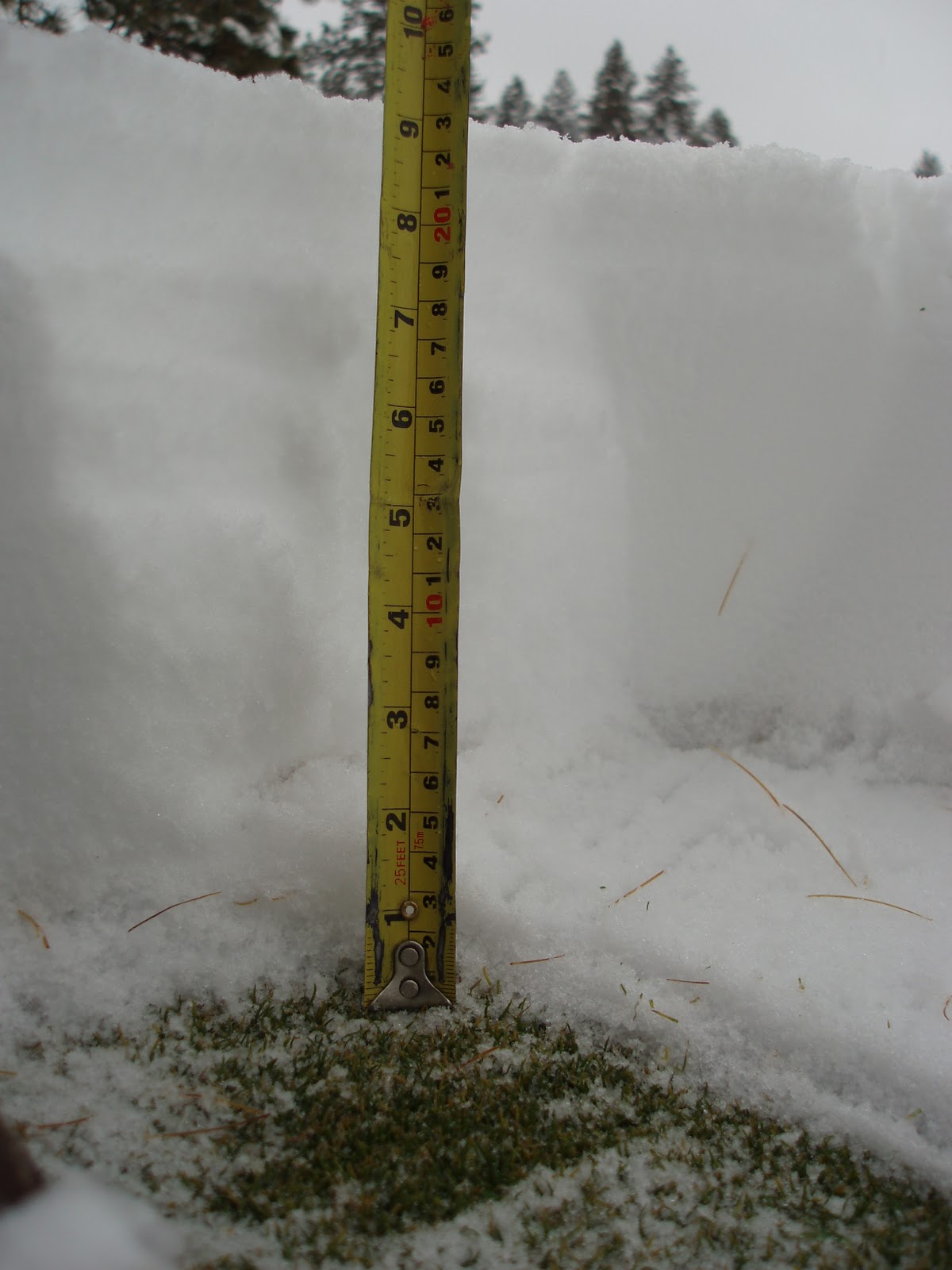
14" total snow in this picture
Since taking the previous picture we've had another 3 to 4 inches of snow.

I did take some samples from greens earlier this month to get feel for what may be going on.  The frozen ground dictates a slightly different tool selection than normal.

Old cup cutter and sledge hammer are the only way to get samples
The problem with frozen ground is the difficulty in pulling a complete plug.  Basically, all you really get is small slice that seems to break at the interface between the sand and thatch.

Fresh Plug, 12 Green
My first plug was from 9 green since it is the one of the ones I am concerned about.  After digging and chipping I was able to do a little "scratch and sniff".  As flaky as this sounds, the process involves closing my eyes, clearing my thoughts, inhaling deeply and letting the smell tell my brain what to think.  I've said it before and I'll say it again, but when I smell grass in the middle of winter I automatically think of the color green.  This time out, however, I smelled sour which for me triggers a brown color in my minds eye.  I pulled a plug and brought it indoors and was glad to see it green up and grow.  The weird part it is only the Poa growing.  My guess is since the plug was difficult to remove and very, very shallow most of the roots (and possibly crowns) from the bentgrass would have been left behind in the frozen ground and, as a result,  any bentgrass leaf tissue would all fail to grow.

I've been out to the other greens with ice on the surface and early indications (smell and, as in the case of the plug pictured above from 12 green) appear less threatening than those so far observed on 9 green.  The plan is still to monitor the surface as best we can by randomly digging test pits and pulling plugs if conditions (i.e. smell) dictate it throughout the remainder of the winter.  I'll check the greens tarped with the semi-permeable covers next week and comment on any thing I see.


Thursday, November 24, 2011

Week of November 20th

The was not the weather I wanted in the middle of November!  After that nice 15 cm of snow last Thursday we had another 11 cm come Tuesday a.m.  However, that was followed by one inch of rain over the next 2 days!  By the end of the rain the snow had been compressed 50%  to just to over 12cm.

Just under 24cm snow Tuesday a.m


Just under 12cm (radio is 12cm to base of antenna) on Thursday

I was fairly sure ice would appear on the surface of the frozen greens but as of today, Thursday, November 24 there doesn't appear to be any ice on any of the surfaces I checked.  Even better was the fact that those greens that were frozen seem to have thawed slightly which is maybe why no ice developed.  The forecast is for fairly normal weather (flurries, highs near zero and lows around -4 degrees Celsius) which is good.

Situations like this are far from my favorite but they do help develop a data base of experience which can aid in making decisions next time out.  Before we went and checked each green yesterday, I was under the assumption that a rain event of that size would be a problem since that has been the case in years past (anybody remember 18 G the spring of 2008?).  Even after having the worst case scenario I talked about in the previous post play itself out and things now appearing "rosy" I hesitate to comment on how the turf will overwinter.  Heck, we still have one week of November left!  I've been spraying the greens as late as December 14th so, suffice to say, we are not out of the woods yet.


Thursday, November 17, 2011

It's What it is Now

15 cm last night.  Hopefully, it is here to stay!  We've been monitoring the greens, specifically #4, and ended up leaving things alone.  I guess the good news (ice wise) is nothing has really changed or gotten any worse.  The extra snow is actually nice since it will help buffer any dramatic weather changes.  Best case it keeps snowing from now until March.  Worst case, above normal temps with rain.

Yesterday one of the "herd" had a problem:


This deer managed to get his antlers tied up in the netting on the driving range.  Luckily for him, someone saw him near the end of the day.  I wasn't involved but I guess the extraction procedure involved a bit of a tussle and, apparently, the buck still has chunked of netting wrapped up in his antlers.  Could have been worse.

Monday, November 14, 2011

To Snow Blow or Not To Snow Blow.....

That sounds a little melodramatic but that is one of the arguments I've been having with myself since last Thursday (Nov. 10th).  As referenced in the last post, the small layer of snow remaining on the greens could be a problem.  The forecast last week was calling for increasing temperatures and possible showers.  We ended up making the call last Thursday to remove the thin layer of snow on those greens where ice could develop.  The real troublesome greens were already tarped so the greens we removed the snow from were those greens that had a frozen surface, had some occurrence of winter damage in the past, and where the snow had slightly melted .  The other greens that hadn't really seen any late season heat still had a couple inches of snow on their surface so we left them.  We ended up taking the snow off of 4, 8, 9, 10, 12, 18.  The moisture that ended up coming was a mixture of wet snow and rain and made for some interesting conditions.
Snow Layer 14G
By Sunday most of the greens were like the above picture: a fluffy snow layer over corn snow over frozen ground.  The corn layer is porous but tight and crumbled with little effort.  The greens that had the snow removed were a bit different.

9 Green
Obviously there was less snow in general and the surface on all (with the exception of one) were slightly thawed.  Again the snow layer was a tight corn snow but still came off the surface with minimal effort.  The funky one is 4 green.  The surface is bullet proof and the snow cover is very solid or, dare I say it, "ice like"?  The layer is small and does come off with a bit more effort but now we have to decide what it could turn into.  Again, the forecast is for more snow which puts a time constraint on removing the snow from 4 green since I would want anything left on the green surface after snow blowing to melt.  Also, forecasted overnight lows are below -10 degrees Celsius and exposing a partially melted surface to that temperature is pretty much a guaranty for ice.  There is always a way to rationalize your choices but it is only with the benefit of hindsight do you know if the right choice was made so, again, To Snow Blow or Not To Snow Blow......

Friday, April 15, 2011

Speeding up the Spring

Anybody living in Kimberley knows what kind of Spring we've been having and how it is dragging out with respect to the melt. Once an area is exposed the surrounding snow goes rapidly but if there is any shade, especially during the afternoons, the melt is definitely slow. This week we decided that if we are trying for an April opening we should address those lingering snow areas. Spreading dark material is the one way to speed melting but since the snow is fairly deep in some areas we had to knock it down to a level we could work with. (see
http://kimberleygolfclub.blogspot.com/2009/11/snow-at-beginning-of-week-was.html for a bit of history re: snow removal from the fairways). The tractor was used to drag snow into the exposed areas in the rough.


Tractor dragging snow

We followed up by spreading a sand/organic mix over the remaining snow and sat back and hoped that the forecast was wrong and we would get some sun. However, this morning (Friday, April15) we arrived to work and found this:


The picture looks worse than it is but there was a couple inches. Not very much but what it does when it melts, obviously, is make everything wet again and adds to the further delay in getting equipment onto the course for clean up. Opening could still be next weekend but at this rate it is tough to commit and I promise we won't have all the clean up completed. Stay tuned.

Friday, January 21, 2011

No Good Pictures but No Bad News Either

It took a few days to visit all the greens but I finally managed to get to each green and dig down to all surfaces. The level of snow varies from 19 inches down to 11 inches with a majority of the greens on the back having the most snow. All surfaces are thawed and only one, 12 green, has a very small ice layer on the back tier. When I'm checking for ice I generally have a good idea where to go on each green based on past ice events, shading from trees, and my "spidey sense". It would be pretty bold to say everything is rosy but based on observations from the chronic problem spots it seems that there was no real negative impact (i.e. ice formation) on the green surfaces from the past weeks warm weather. At present, we have a 2 to 3 inch hard crust over a loose corn snow done to a buttery soft green surface. What now? For selfish reasons I would like another series large of dumps until mid-March and then it can stop. However, if no more real snow comes I'm optimistic that we have enough protection until spring.

Monday, January 17, 2011

Could Be Worse


14" Snow on 18 Green
Monday, Jan. 17

We have 3 days of rain and above normal temperatures under our belt and the snow is changing. Today I checked some select greens with chronic ice problems and things appear O.K. The amount of snow has dropped from 20" on Friday to 14" today. The consistency of the snow is no longer dry but has more of a "Mr. Misty" feel (a dated reference to a DQ treat) versus a "Slurpee" feel. What I mean to say is there is no real flowing water and the melted snow seems to have re-frozen into a small, loose ice granules. There is no longer defined layers within the snow profile (as mentioned in the last post) but instead the snow is more uniform top to bottom. Most likely the insulating and water holding/trapping characteristics are all but tapped out. A continuation of this and we may be facing a scenario similar to 2008. That year we had a similar situation (rain, days of above zero temperatures, and decreased snow integrity) quickly followed by a large drop in temperature and the almost immediate formation of surface ice that resulted in severe damage to 18 green. However, some things in our favour this year are the large amount of snow at the start of the warm spell and the fact that most surfaces are unfrozen. Also, with respect to 18 green, we installed extra drainage (see http://kimberleygolfclub.blogspot.com/2010_02_01_archive.html ). We will continue to check the greens and keep and eye on developments until it looks like things have stabilized.

Friday, January 14, 2011

Snow Pack


20 inches (50 cm) of cover on
January 14

Middle of January and we're getting rain. Disappointing but not unusual. The good news is the existing snow cover is fairly resilient. Starting on Wednesday (Jan. 12) and continuing through to Thursday (Jan.13) 9 inches of snow was added to an already existing 16 inches of snow cover over unfrozen ground. At this point, the only thing the warm weather and rain has done is consolidate the most recent snow fall from 9 inches down to 4 or 5 inches.

One of the things in our favour right now is the layers that are within the 20 inches of snow. Five inches down from the top is a small, thin crusty layer that could help to slow any water percolating down onto the green surface. Five inches below this thin layer is another thicker band of "snow/ice" that resulted from exposure to an earlier warm spell back in December. This thicker layer could also slow or stop any water from reaching the green.


Layers with the snow cover
on 9 Green

The one more good thing (depending......?)as I mentioned in a previous post is the observation that most of the green surfaces are not frozen. If water did reach the surface it could easily continue into the root zone without the development of ice.

I've seen late season ice develop over unfrozen ground before. Usually, the ground temperature melts the ice from the bottom up and a little air layer develops between the ice and the green surface. As long as the ice is not so dense as to completely seal off gas exchange, is not on the surface for more than 30 - 45 days, and does not grow thicker damage can be minimal (the usual caveats apply to such a general statement: plant health and nutrition, plant spp., blah, blah, blah, etc., etc.)

I'll keep a watch over the next week or until the weather changes to monitor any changes to the greens surface and post any observations.

Monday, December 13, 2010

December

It's coming up to almost one month since my last post and, as I indicated at the very beginning, that means there isn't a whole lot to talk about. Most of our time has been indoors tying up loose ends. I've slightly obsessed over updating and bettering our record keeping for fertilizer and chemical applications on the golf course. I've been trying to tie in our inventory to our application records in a "real time" sense. Previous years records help with purchasing in the new year but turf conditions, weather, maintenance practices, and gremlins can change the amounts of products used and the timing of applications. Sometimes we are unsure of where we stand with respect to the amount of particular product so, obviously, a more accurate method of tracking will keep us better informed of where we stand during the growing season.


#18 Green
Seeing an smelling "green" under snow cover
always makes my day.

Last week we checked conditions on green surfaces and found all but 5 were completely unfrozen and had no ice layers on the surface. Of the 5 frozen greens two were tarped (7 and 15) and the remaining three (12, 14, and 16) were untarped. What does all this mean? Its early to really comment but, generally, unfrozen surfaces suggests a year with high disease pressure. This may only be an issue on those fairways we did not spray and/or those fairways we experimented with "lite" spray rates. I'm fairly comfortable in saying that all the sprays applied to the green surfaces went well so disease on the green surface during the winter should not be too big of an issue. We have about a 11" (28cm) snow cover which should be able to absorb any small rain events. Moderate to heavy rain and mild temperatures will affect the integrity of the existing snow but any melting snow or rain making its way to the green surface should soak in since most of our greens are thawed. However, all bets are off if we have a catastrophic rain/melt event like we had in December 2007 (we had to sod a portion of 18 green in the spring of 2008 because of ice damage).

Tuesday, March 9, 2010

Snow Melting Experiment

A bunch of different things have happened over time to make me want to rid the golf course of snow quicker than usual. 1) I received a broucher in the mail a while back promoting the idea of using black sand to speed the melting of snow (assuming it is always sunny!). 2.) The possible threat of not re-registering a product we depend on for snow mold control. 3.) The development of a "biological" snow mold control. 4.) The increasing costs of fungicides. 5.) The push to be more "environmental"

First a little primer on snow mold: I'll generalize a bit but most of the winter disease on KGC is either gray or pink snow mold. Both diseases survive the summer as a spore within the thatch layer. The spores germinate in the fall and grow under snow cover (especially when there is plenty of snow over unfrozen, wet ground). A level of control is achieved by applying fungicides in the fall that limit growth of the germinating spores. Some fungicide efficacy is lost over the winter allowing for the development snow mold in the early spring. The decreasing control is one of the reasons why we blow snow off the greens if we think the disease pressure is high.

Greens will never be able to overwinter without some form of chemical disease control. However, with our fairways there is a greater "buffer" to handle some level of disease. The surface area is substantially larger (the fairway area on #16 alone is equal to the total area of the greens), some grass species (fescues and Kentucky blue grass) that exist on our fairways are somewhat resistant to snow molds as compared to the mostly Poa annua species on the greens which has no disease resistance, and the fairways can handle a little more abuse because they are maintained at a height of cut (3/4 " for fairways vs. 5/32" on greens) that allows them to recover quicker from winter damage.


If we can melt the snow and get the turf surface to dry quicker we will have less incidence of disease. The picture on the left shows about 7 to 8 inches of snow on the driving range. We ploughed a series of roads so we would be able to spread the sand on top of the snow.

The picture on the right shows how much snow melted after 7 days. Temperatures ranged from -10 at night to +9 during the day with mostly sunny conditions. If you double click on the pictures you get a better idea of how much melted in a short time. We will use this for melting the small amounts of snow left on our greens in the spring when we think it is appropriate.

We will see how quick the exposed areas on the range green up to the area we left the snow on. With a few other techniques (such as dethatching) we may be able to lessen the severity of winter disease damage on areas such as the fairways.