Showing posts with label ice. Show all posts

Tuesday, November 29, 2016

Uncharted territory....

As usual the title of this post is probably more dramatic than it needs to be but, admittedly, I feel somewhat lost.  The weather has been interesting to say the least but my memory is short so I'm glad I have a weather station keeping records.  Unfortunately, I assumed the website I was using kept historical weather but it appears they only go back one year so I've lost portions of weather data pre Nov 1, 2015. Not a big deal but inconvenient to be sure. Luckily, I wrote about the fall weather in a post last December (go HERE) which included some screen shots highlighting conditions. Last year after my last spray we had close to 45 mm of rain but cold temperatures and snow cover by last week in November. For this year we've had plenty of rain (85mm of rain from start of October to middle of the month and another 106 mm since 3rd week in October) and mild temperatures which makes for very high disease pressure.

The main "goto" fungicide application sprayed in late October has seen a good portion of the rain (86 mm) since it was applied and based on last years results we can assume its efficacy has been affected.  I've had to reapply fungicides 2 times already to control developing disease and now I'm hoping for clear cold weather for next couple weeks if for no other reason than to make condition less conducive for disease development.

Because of disease pressure I've been attempting to manage the surface environment as best as I can by removing snow from the greens (which, for some areas, I've done 3X already) with a homemade tool Neil L. created.

1st version - all manual

2nd version - automatic lift!
I am limiting surface moisture and hopefully encouraging the ground to stiffen up. Frozen ground slows disease but can be bad news regarding ice since any rain may very well freeze on the surface if it doesn't run off.

It seemed a bit futile to remove the small amounts of snow we've been getting since they melt within a two or three days so I left some snow from the last skiff to melt on a few greens to see if I was wasting my time. But I ended up with this:
Pink Snow Mold

The fuzz is mycelium and I know it's the bad fungus since it is on the periphery of damage caused from an earlier bout of disease. The interesting part is it only appeared on those greens where I left the snow to melt. That says 2 things to me:
  1. Despite the concern I have regarding any potential wear and tear on the greens by plowing the snow off the surfaces (time will tell) I am having a positive impact on controlling disease.
  2. My initial sprays have lost much of their control
I did re-apply a mix of contact fungicide and so-so systemic fungicide on Sunday so hopefully I can get the control I need to get through the winter. As risky as it is, I will continue to remove the small snow falls to mitigate the development of any disease but I won't be able to do that for long especially if we get any amount of snow at one time.

I should point out that the certain greens like 3,5,10,11,13,16,17,18 and both PG's are 95 to 100 percent good and have not seen any new disease development since the last spray in middle of October. However, 2,7, front portion of 8,9,14, and 15 are the greens that are being quite troublesome.  15 is a real problem since all the "new" disease occurred under the tarp and now I'm concerned about putting the tarp back on. I know that green gets ice every year and ice kills outright so the tarp has to go down but I'm sure when and how that will happen.

Tuesday, March 3, 2015

In Like a Lion.....

You know the old saying.  I guess we just have to wait until the end of the month to see if it's true.  The impact of this type of snow and cold over last couple weeks on the course should be negligible.  It's put a bit of brake on attempting to do any work on the course but the good news about March snow is it seems to melt faster with the longer and warmer (?) days.  Things are still frozen and since we've been cold there hasn't really been any more ice develop.  Possibly this snow may provide some insulation so any heat coming from the ground might warm the surfaces under the snow and help melt any ice that has already formed....probably just wishful thinking.

As we get closer to opening some of the planned projects are coming on line.  The clubhouse will receive a thorough cleaning and painting throughout the upstairs dining room, washroom, and kitchen areas.  Also, the wheels have started to turn on the golf clubs water connection to the Mathew Creek water line.  I referenced connecting to Mathew Creek in the past (go HERE) and with money from the sale of assets last fall it was decided that now would be the time to establish an emergency/back up water source.  It's not perfect but for our cash situation it's a reasonable alternative.  It might be extremely fortuitous that we choose this year to finally address an alternative water source since the River Forecast Center shows the East Kootenay at 80% of normal snow amounts.  If we continue to see dry and above normal temperatures for the summer our source at the river might dry up sooner than normal.

We've actually been busy at the shop for a February since the new mechanic we hired started earlier than usual.  Unlike last year when the dude I hired in June sort of got baptized by fire, I wanted the new hire this time out to have the option to get familiar with the equipment and type of maintenance required before staff comes back and things start falling apart.  He's been at it for a month and has cleaned up a lot of  loose ends left dangling from last year and is making very short order of the repair list I created at the beginning of February.

We will start to move out onto the course this month and most likely we'll begin removing snow from the tarped greens (starting on #15) before or near the middle of the month, weather depended.  We also plan on removing some trees (a couple missed green attack Ponderosa pine) on the left of 2 green and some on the left of 12 green and possibly the back of 15 green .  Next time out I'll give some detail and pictures highlighting those events.

Monday, February 16, 2015

This can't be for real.....

Second week in February and we have a snow pack from 0 to maybe 9" in the real shady spots.  Those numbers are more like late March!  Like I said in the last post we didn't want rain and above normal temperatures.  If you've been in Kimberley for the last three weeks you'll know that's exactly what we got. As it stands now we have a mixture of thawed greens with no ice, some greens with thin ice over a mostly thawed surface, the odd one with ice/slush, and still some with frozen surfaces.  All things considered I'm still optimistic since I know when, where and what greens started to get ice and in all cases the ice is very thin and every green has that nice "green" smell.  The following pictures are from Friday, Feb. 13.

9 Green
18 Green
16 Green
When I had another look around on Sunday, Feb. 15 I saw less water/slush and more thawed surfaces.  Although it is somewhat true for most years, this year is turning into one of those years where the spring temperatures and the melting conditions will dictate the condition of the greens at the start of our year.  With the melt being so early and there still being lots of potential for cold temperatures the chances for damage from crown dehydration (freeze/thaw damage) and/or direct low temperature kill (for the poa only) are of far greater concern this year than in those years when the melt and turf exposure has occurred at a more traditional time.  Right now the strategy is to track the ice formation and keep an eye conditions under the ice and, I believe, delay exposing anything deliberately until we get closer to the middle of March.

Oops, forgot to add this little reading for you.  I sometimes have trouble digesting the gimmicky trends floating around golf to increase play.  The following article (GO HERE) touches on those trends and I find myself sympathizing with the authors views.  Take a look and see what you think.

Thursday, December 18, 2014

Freaky Friday Follow Up

With first day of winter just around the corner I thought I'd give a brief update of how we made out after last week.  Right now, I am glad I didn't panic and attempt to remove any more snow than what I did.  With respect to #9 and new putting green things did not change which may mean problems in the spring but I suspect we may not have too much to worry about on #9...just a hunch (or hope?).  The rest of the greens I that I've looked at appear like this:
#2 Green Surface
If you remember the last post I said things were developing a more solid surface layer.  Now?  There is no layer like I was seeing last week.  Not sure why but I'll take it.  There is just over 3" of snow which has similar properties to styrofoam (dry, hard, strong).  Unlike styfroam, I don't think there is much insulation in this cover so temperature swings may have an impact.  Because the turf is dormant I don't think cold will negatively impact us but mild above zero temperatures (especially overnight) and rain may cause problems unless we get a good fluffy snow cover within the next little while.

Despite the fact that we're entering a slow time work/golf wise I will keep an eye on things and provide updates so check back often.

Sunday, December 14, 2014

Freaky Friday....

...which hopefully won't turn into Sh*tty Saturday.  The pineapple express is at it again and as usual it's created some headaches.  The mild temperatures during the day and night combined with the rain have pretty much saturated the snow covering the course.  Since none of the green surfaces are thawed (I had to dig a valve up last week and needed a pick ax to break the top 6" of soil before I got past the frost) the slow trickle of water through the snow is starting to freeze on the surface.

"Pebbly" Looking Green Surface
A quick survey yesterday of all the greens (except 13; I haven't been there yet) revealed all the greens have a similar type of appearance.  Basically, the somewhat loose surface granules have started to coalesce into a entity with more substance (sort of tap dancing around saying it, aren't I?).  The new putting green has got this going on:

Dreaded Clear Ice
Now what?  I suspect that there is very little buffering capacity left in the snow cover and we won't be able to ride out another bout of wet weather like we just had without making things worse; however, I also suspect that since most greens surfaces appear similar to the first picture and not the second we may not be that bad off.  To back up this suspicion with more than just my "spidey sense" I decided to experiment a bit.

The '' Ol' Wishy Washy Split Plough on #9 Green
Why only half?  This way I can be right and wrong no matter what happens in the spring!  But truthfully  (assuming things don't get any worse ice wise) I'm not sure the surface has enough ice cover to be overly damaging.  I do know that it is not uncommon for dense ice to develop when you plough wet snow and the surface doesn't completely clear off but luckily for us by the end of the day the pebbly ice looked like this:

Crumbly Ice with Air Gap
This layer sort of comes off with a bit of work but I'm going to leave it one more day and see what happens.  And finally...

Yea, That's Ice

I removed all the snow from the new putting green and by the end of the day not a whole lot had melted. Let's call it day 1 of ice cover on that girl.  Again, we'll see what tomorrow brings but that one might be funky in the spring, just saying....

Monday, December 1, 2014

Winter Update.....

Those 25 degree temperature swings in less than 12 hours are tough to handle.  It's back into the deep freeze with overnight lows below -21 Celcius.  Although we did not receive much rain, the above freezing temperatures had a significant impact on snow level and moisture.  The best way to describe the snow was "creamy"...or really wet "mash potato" snow over a very thin "corny" ice.
3 Green


By Friday night it was still rainy but ultimately we got the dump and temperature drop the forecast called for.  I checked conditions late Saturday and there was actually standing water and slush under the snow despite the cold temperatures.  I knew I had to wait to get an honest feel for conditions so I didn't check until today (Monday).  So far this is what I've come across:

3 Green, again
 We have close to 4" fluff over 2" of frozen "mash potato" on top of close to 1/2 corn ice.  Some other greens have similar but the surface ice has a bit more substance but still somewhat removable and not the dreaded clear ice.  I still have to go to all greens to get an idea of what's out there.  I am sure 15 will be covered with ice, hence the tarp.

Not an ideal situation but not exactly uncommon either.  I'll keep monitoring to see if anywhere develops more severe ice but as it stands now the turf is at it peak strength dormancy wise so I am comfortable with leaving things as is.  As usual, it's later on in the season when the problems can really develop so stay tuned. 

Wednesday, November 26, 2014

Keep Your Fingers Crossed.

Short update.  Luckily the snow has been slowly accumulating and any little amount we get moves us further away from the "death zone" (go HERE for explanation).  The forecast is still for rain with above freezing temperatures for the low on Friday which is not great but the good news is it appears to be very short lived since for Saturday the forecast high is -12.  I know I've expressed my displeasure with November before and this year is doing nothing to change my attitude.  I was unable to put the tarp back on #9 mostly because the initial snow never melted and I wasn't to thrilled about blowing it off.

On Monday, the forecast was periods of rain Thursday and Friday with above freezing temperatures over night.  I watched the weather and had that forecast stayed the same I would have started snow blowing the green surfaces on Tuesday.   However, snow overnight on Monday and period of rain changing to 60% showers on Thursday and just rain for Friday (not periods of rain, when they say that experience tells me its going to pour!) have made snow blowing greens less likely.  Also, compounded by the fact that it is snowing right now, I am hopeful we will have enough of a snow cover to be able to absorb any moisture in the form of rain without creating surface ice.....we'll see if that is the case in about 48 hours.

First draft of budget is done and once Novembers numbers are in I'll be able to take a closer look at where time and money was spent.  Already, I know there was 1200 less staff hours in my department this year versus 2013.  I'll take a closer look and let you know what was different this year.

I thought it would be fun to post pictures of the wildlife that is around the golf course when there is no play.  I bought a trail/game camera on sale this fall and put it up in various spots.  I had a fair amount of deer and elk pictures but none were great to I set the camera up near 2 green on a heavily traveled game trail just over the bank.  Some pr*ck stole it!  I'm obviously naive or people are jerks...or both!  Anyways, the only wild life out of the ordinary for us is these guys:

Dudes, go south!
The fact these geese are sticking around is bugging me.  Hopefully, it's not because they think the snow is going to melt and more because of the poor flying weather (?).  We watched a coyote take a run at this flock and he struck out.  I like them it's too bad they are messy.

Wednesday, January 2, 2013

A Brief Brief

Almost a whole month and no post!  Basically, that means not much to report.  I just did a look around and took a look at some of the surfaces and things appear pretty good for January.  We have close to 11" of sugar over 2 to 3 inches of corn over a definite 1 inch ice layer on those greens I did not snow blow in November.  The good news is the ice is very easily broken and is separated from the surface by a nice air layer and everything smells "green".  The greens that had the snow removed have no corn or ice layer and are pretty much sugar all the way down to the surface.  I didn't have a tool with me to check and see how frozen the surfaces were so I can't really comment on that.  As usual this only means we've gotten this far without any obvious "situations" but we have a long ways to go.

Monday, December 3, 2012

Man, I Hate November....

If there was one month I could do without it would be November.  No golf, no skiing, grey skies and sucky weather.  The last 7 to10 days have seen conditions change from snow and winter to open turf, slush and ice because of rain and then back to winter.  I can now say removing the snow from select greens earlier on was the right choice, especially since the surfaces were covered with a nice snow layer soon afterward.  I left some of the slushy snow on one section on 9 green and watched what happened to the snow conditions and observed that if I had left the wet layer of snow on those greens I'm pretty sure we would've had the beginnings of an ice layer.

Layers on 9 Green
I didn't get to pat myself on the back for long because the weather went funky again and we got rain and mild temperatures and we were right back into another tough spot 7 days later.  This time I did not remove the snow mostly because of the amount and the wet weather.  There was enough snow and so much moisture in the snow that the blowers would not have been able to throw it far enough without us having to double handle it.  Further, once you start to blow snow that wet you have to get it off because it is guaranteed to form ice.  Anyways, the hope was for mild temperatures for a few days and maybe even rain like we had earlier on to get the snow to a more manageable level.  No luck.

Multi layers #11 Green
Now we have 7 cm fresh snow over about 3 cm "tight" corn snow over very thin ice on those greens we did not blow the first time out.  The greens we cleaned have about 6cm snow over 2 cm tight corn snow layer.  All surfaces are unfrozen and if we get a good cover before the temperature really drops that could help keep that corn layer from getting more ice like.  

Saturday, November 24, 2012

All bets are off....

As alluded to in the last post, this time of year is tricky.  Early in the week the weather forced my hand and I had to make a choice.  The rain and the "warmish" weather did a number on the snow cover on the certain greens.
2 Green,  November 19th
The greens on the front that can be difficult are covered with impermeable tarps and look like this:
1 Green Tarp
For both these situations there was not enough cover to worry about ice formation but only because the ground is not frozen.  In this situation, however:
4 Green
I was slightly more concerned.  Ice could become a problem if the temperature dropped significantly so we blew the snow off of #4, #5, #10, #18, and #8 greens with the hope of "managing" ice formation (the upper putting green, 2, and 3 greens basically melted while 1, 6, 7 and 9 all had some sort of tarp on their surface).  As I've mentioned, blowing snow opens surfaces up to the potential of freezing so it is sort of a risk but the quantity of moisture in the snow pack (wet slush) for those greens forced me to make a decision. Luckily, those greens only remained exposed for a couple days and never froze.  We now have close to 4" of snow on the front greens and no sign of any ice on the greens we cleared.

The back greens (other than 10, 18 and 17) had more snow so I decided not to blow those greens.  To be honest, we really did not have enough time to clean them anyways.  I went out today and looked and saw 4" fresh snow over a plate glass layer of ice over an inch of corn snow over unfrozen ground.  That says to me leaving those greens may have been O.K. but it is early and my crystal ball doesn't look any farther ahead than to my next meal so, like I said, "All bets are off".

Saturday, November 17, 2012

The Death Zone.....

I sometimes equate November with that point you here about on Everest called "the death zone" or "the point of no return" or some other euphemism that has foreboding overtones.  Now is that time just before winter when the weather can do funky stuff and you can be forced into making snap decisions that you're stuck with for the rest of the winter based on nothing more than your spidey-sense. 

Right now we are in good shape with all greens having a little snow cover and none of the surfaces frozen. 

4 Green With About 1.5" Snow Cover

15 Green With Thin Ice Layer Over Tarp
Why an unfrozen surface is good this time out is because of how little snow cover we have and the potential for rain in the forecast.  Do we take all the cover off to limit the formation of ice or do we leave it and hope for enough rain to melt all the snow or do we leave it and hope that because of our elevation we get snow and not rain? At this point the temperature is suppose increase so along as the over night lows stay above zero it won't take long for the snow to melt, especially if it rains.  If we lose our cover we are back into the possibility of the ground freezing and all the problems that inadequate snow cover can bring.  Then again none of this may happen but I like keeping a record of what I think in these situations and look back and criticize my choices.

Thursday, June 7, 2012

Trying to Figure it Out

It's probably the farthest thing from your mind but this post is a review of winter damage we experienced this year.  One thing I am learning is just as it takes multiple inputs to make the turf appear good it also takes more than one thing to cause damage.  I am always looking for common denominators to explain damage.  It's only with the benefit of hindsight do I think that one of the factors impacting spring conditions was the level and condition of the snow cover on the greens this past winter.  All the areas damaged this spring were prone to poor snow coverage during one or multiple times through out this past winter.

What really got me thinking about this was comparing the snow pack (depth and consistency) between 12 and 13 greens.  In late February there was 8" of tight corn snow on 12 green over a 1/2 of surface ice.  On that same date 380 yards away on 13 (a green with the same aspect) there was 16" of loose corn snow over an ice free and thawed surface.  Why?  Both are surrounded on the left and back by trees but the trees on 13 are much farther away so, it is my theory, that the trees influence (in this case shelter from snow) was limited; i.e. less shelter from the trees on 13 so more snow on that green versus 12.  

The damage on the front left of 1 green, I think, was caused by the trees acting as a heat sink.  During sunny days they would absorbed heat and radiated it at night.  Stupid sounding I know but I've been around enough times to see the snow melt first on the south west side of these trees to know that it is a very common occurrence.  This happened a few times early in the spring and combined with the snow events we experienced in March I think that area went through a series of melts that created a number of freeze/thaw cycles that ultimately killed the turf. 

Front Left #1 Green
What about the wrinkles of green under the tarp on #1 green?  This was where the semi-permeable tarp created insulating air gaps between the turf and the ice (a case for insulating greens prone to early season melting, i.e. bubble wrap).

Now the putting green.
New Putting Ice Layer
It too is prone to early season melting and freeze/thaw exposure.  I've never worried about it because of the bent grass component.  This time out I think the green was unhealthy going into winter and did not have the CHO reserves to cope with the freeze/thaw and ultimate anoxia created from the ice layer that developed.  For this green it was probably that one-two punch that caused all the problems since the lower half, which was completely playable early on, had the same lack of fertility but no ice.

What about 9 green? Remember this?

Ice Removed From Back #9 Green
I exposed it thinking the damage was done so what could I lose?  Interestingly enough while the back has mostly recovered it is those area on the right side that I did not touch in February that are still slow to come.

#9 Green One Day After Black Sand Melted Snow
Probably that damage relates to the melting of the snow I did in early March.  During that time the temperatures ranged from -14 to +10 and I think the mistake lies in melting the snow too fast (creating free water) and too early.  At the time I was concerned with a slow melt and freeze/thaw damage.  It may have been better to blow what snow I could, melt any ice and then tarp the green.

All these areas struggle with shade during the spring and fall but so do other greens and they weren't damaged.  But, again I think, a possible common denominator is the condition of the snow cover.  Most all other greens had a deep snow pack and were slow to melt.  The real kicker for me is the damage on 12 green.  The worst area is the spot where I exposed it very early thinking I was limiting the ice damage.  The rest of the green that I left covered was still damaged but has recovered faster than that back tier that was exposed earlier -- opposite as to what has occurred on #9 green.

Next winter it will be a different story.  I know this is long winded and awkward and maybe I've over explained stuff but I think with the way this spring has shaped up for golf courses in this area people should know that the choices made when dealing with winter can have different results within a golf property let alone different results between golf properties.

Tuesday, March 20, 2012

Sorta like bangin' your head against a wall....

March 20
 Another day and another 4 inches.  The naivety of my earlier comments regarding exposed turf back at the beginning of March are glaring obvious now.  I like snow so it really isn't too disappointing but my hamstrings are still aching from hitting the slopes and chewin' some pow last week so I was looking forward to the change of pace that work can bring.  Snow pack is back up over 18" as of yesterday and after today (Tuesday, March 20th) I'll bet we will be close to 2 feet in the shady spots.

Last week we started clearing off number 7 green which is the only green with an impermeable cover ("ice shield") which is fairly typical for this time of year.  I try to get the impermeable tarps off first since they can create problems if they are left on too long. 
Pushing Ice off 7 Green
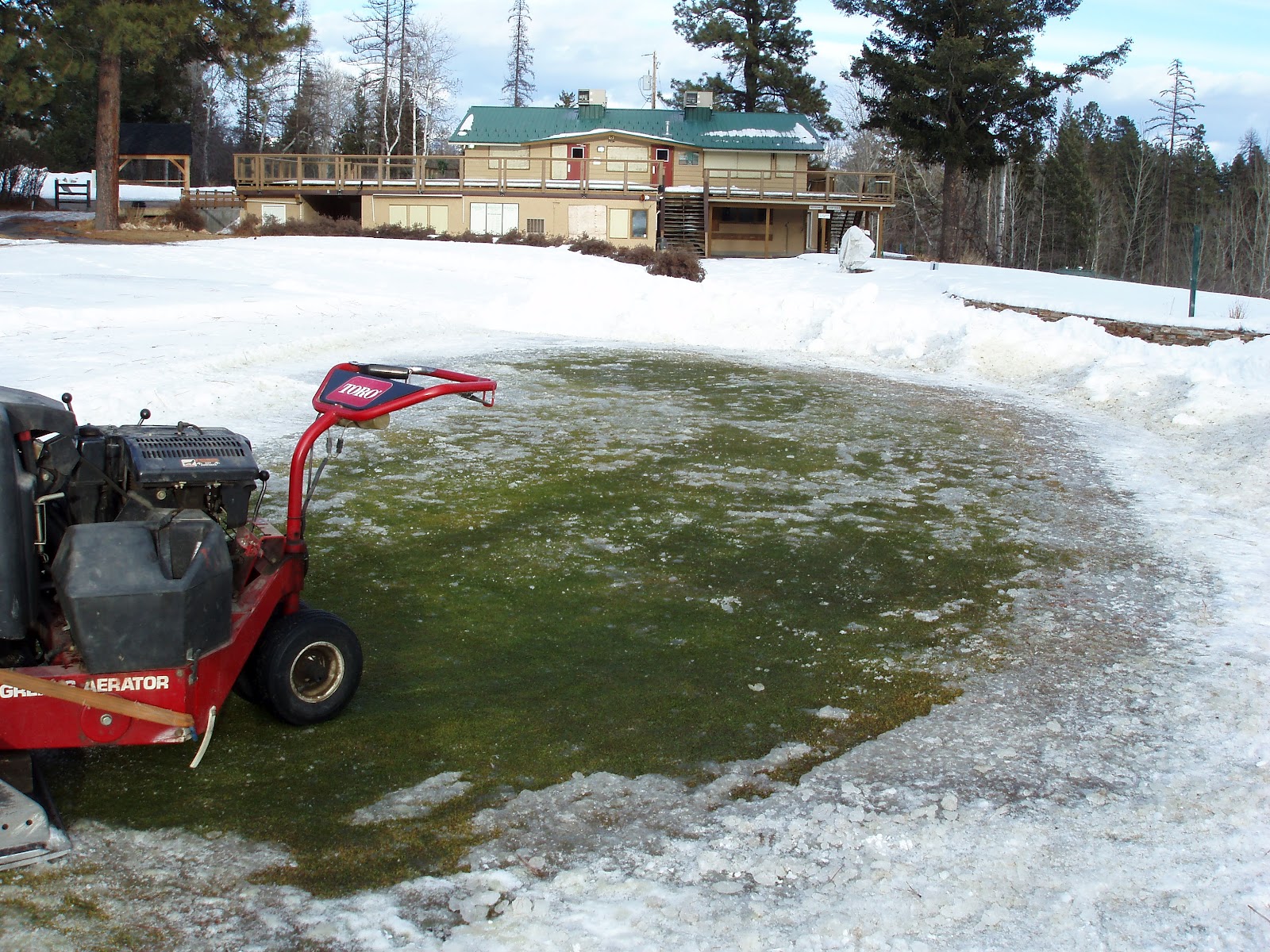
We were a little over half done when it snowed overnight and that made it awkward to use the Bobcat so we switched gears and went to 15 green thinking the snow on 7 would melt within a day or two.  There is a lot of ice on 15 so I want to get it off.  Ten days ago water was puddling on 15 so bad we had to cut a trench to direct the water off.  Most of the free water that did not run off formed ice so we needed to use the old aerator and chip away at it.  It was slow and by the end of day 2 we were just over half way and then it snowed, again.
Tools of the Ice Removal Trade
 Now what?  More blowin' and chipin', I guess.  Really, a normal year would just have us starting to remove snow from the tarped greens this week.  We usually wait until mid-March mostly because March snow storms aren't exactly unheard of and, also, I am usually not as uptight as I am this year because of the ice on certain greens.  I think I am cautiously optimistic but until all greens are clear and dry I will find it hard to comment on course conditions without a ton of disclaimers.

Friday, March 2, 2012

Blowin' Snow

Over the past week we've begun to remove some of the snow cover from select greens.  This time out we had the ability to leave a 4 to 6 inch snow layer behind.  This layer goes back to the rain we had in December of 2010 that ultimately contributed to the ice build up we have on some greens.  By knocking down the snow pack the hope is for a faster melt.  Why not completely blow it off this time of year?  Same old, same old: I don't want the Poa annua breaking dormancy too early and risk death by low temperature or crown hydration/dehydration (a.k.a. freeze/thaw injury).  When we get closer and the weather has taken a turn we will be able to get those greens we blew earlier on and expose them far quicker than if we still had to blow large amounts of sloppy, slushy snow.
Blowin' 4 Green
One problem we have created is the obvious fact that there is now more snow on the surrounds after blowing snow from the greens.  To make matters worse that snow will be bullet proof and slow to melt.  Sort of a calculated risk since I am more comfortable with what damage may or may not occur on the surrounds with a prolonged melt.  Regardless if we blow snow off the greens now or later the same situation with respect to the surrounds would exist but at least now the greens will be closer to being clear.  A little support for our winter/ice strategy appears in an article posted by the USGA.  Click here to go to a short article that talks directly about ice on greens and what to watch for.

Friday, February 24, 2012

Picking at a scab...

Two weeks ago I went and pulled another plug from 9 green  and was disappointed to be greeted with a smell that goes by many names, none of them good.


9G_Feb_17
Although there was green to start with the smell indicated things were far from perfect.

9G_Feb_21
Don't panic yet.  I've been checking all over that green and the problem really seems isolated to back 30%.  Yeah, there is ice over the entire surface but it is not as thick as it was at the back.  Furthermore, the back of that green has a bit of a history of being troublesome.  What I decided to do was experiment and see what happens.  I have mentioned numerous times the risk of exposing Poa in the mid-winter but sometimes situations force you to make a choice.  Any choices I make with respect to managing the ice on 9 will have a limited impact since the damage is done but, even though the area is small, I may be able to glean good "intel" that can be used in the future.

Poa under ice for greater than 45 days will not survive (so says certain research) and bent has over 100 days before it is impacted by ice cover (again, so says certain research).  Research also suggests exposing Poa and even bentgrass too early can have a negative impact on the cold hardiness of both plant species.  More research indicates that the development of low oxygen under ice will also severely impact turf health.  So here's the thing we got ice and (based on smell) anoxic conditions under the ice, we got Poa annua under ice cover for close to 45 days, and we still got winter temperatures.  It's sorta sounds like we are dammed if we do or dammed if we don't or in parlance of Star Trek this is a classic Kobayashi Maru !

I decided that, since the second plug we pulled from 9 green had definitely gone funky, we needed to address the anoxic conditions that existed to limit further damage to any remaining live turf (hoping against all hope that we have a secret stash of Bentgrass hiding within the turf canopy)
Two pieces of equipment you never want to see on a green in the winter

 I used the skid steer to scrape down to the ice and then followed up by using the aerator to chip away at the ice.  It took multiple passes with the aerator in numerous directions before I was able to get near the greens surface.
Initial pass with aerator only left small dimples
It took one guy four hours to get most of the ice off.  After seeing the conditon of the turf once the ice was removed I have a hunch that the most serious anoxia was in small pockets at the back of the green.  Other areas I exposed appeared green and only had a slight sour smell and not the stinky barnyard smell.


Now all we have to do is wait and see what happens.  I did this with a close eye on the forecast.  This time out I wasn't looking to melt the ice only increase air exchange.  I think it is vital that any free moisture been avoided because of the problems associated with repetitive freezing and thawing.  I did this on Thursday afternoon with the hope of limiting the turfs exposure to temperature swings.  Fridays forecast was for seasonal temperatures with snow starting in the afternoon and as I write this I can confirm the weatherman was right on all counts!

Friday, January 27, 2012

Samples

It has been relatively quite this past couple weeks with no real news to report.  The snow is always nice and far better than rain.  The last couple dumps have added another 8" over the hard dense layer to get the snow pack up to a respectable 16 or so inches (similar to other years at this time give or take a couple inches).

14" total snow in this picture
Since taking the previous picture we've had another 3 to 4 inches of snow.

I did take some samples from greens earlier this month to get feel for what may be going on.  The frozen ground dictates a slightly different tool selection than normal.

Old cup cutter and sledge hammer are the only way to get samples
The problem with frozen ground is the difficulty in pulling a complete plug.  Basically, all you really get is small slice that seems to break at the interface between the sand and thatch.

Fresh Plug, 12 Green
My first plug was from 9 green since it is the one of the ones I am concerned about.  After digging and chipping I was able to do a little "scratch and sniff".  As flaky as this sounds, the process involves closing my eyes, clearing my thoughts, inhaling deeply and letting the smell tell my brain what to think.  I've said it before and I'll say it again, but when I smell grass in the middle of winter I automatically think of the color green.  This time out, however, I smelled sour which for me triggers a brown color in my minds eye.  I pulled a plug and brought it indoors and was glad to see it green up and grow.  The weird part it is only the Poa growing.  My guess is since the plug was difficult to remove and very, very shallow most of the roots (and possibly crowns) from the bentgrass would have been left behind in the frozen ground and, as a result,  any bentgrass leaf tissue would all fail to grow.

I've been out to the other greens with ice on the surface and early indications (smell and, as in the case of the plug pictured above from 12 green) appear less threatening than those so far observed on 9 green.  The plan is still to monitor the surface as best we can by randomly digging test pits and pulling plugs if conditions (i.e. smell) dictate it throughout the remainder of the winter.  I'll check the greens tarped with the semi-permeable covers next week and comment on any thing I see.


Sunday, January 8, 2012

What does Ice mean?

A Brief History of 9 Green 
Ice Development
November 13
First snow 
December 29
End result after rain event and the on set of a cold snap.
Earlier snow has begun to form ice on the surface
January 4
More snow, more rain, and more cold.
Poor insulation from shallow snow cover
is causing ice to set up "tighter" 

January 8
Ice thick enough that you need a shovel
to chip ice to loosen it.

Not an ideal start to 2012 but it may be time to start thinking of golf again.  Since my last post in mid-December course conditions and the weather have been somewhat variable.  We've had rain, snow, lows of -18 Celsius, and highs of +8 Celsius.  Over that time the snow has gone through a few changes as demonstrated by the above pictures.  So now what?  First look at "Winter Kill" a post I did back in 2009 for a quick and dirty refresher.  

Ice isn't always the harbinger of death but it makes for some stressful times.  The ice we are seeing now is fairly set up over frozen turf and is no thicker than 1/2 to 3/4 of an inch.  Because I feel the turf entered winter somewhat prepared (versus 2009) it is my hope that the only thing this ice really means is we won't damage the surface if we decide to blow snow. 

At the risk of stereo typing Poa annua (the predominant grass species throughout the entire golf course), the one thing to keep in mind is Poa a nice lookin' grass but it's not very smart.  Any sign of spring like weather and Poa will burn up it's stored winter carbs and start prancing around like it's mid-June.  Without the "antifreeze" like protection the carbohydrates offer even a small drop in temperature below 0 degrees could result in damage from crown dehydration (FYI: intracellular crown dehydration is the sudden freezing of fluid within plant tissue that draws water from cells dehydrating them and killing the turf; extracellular cellular crown dehydration happens the same way but ice forms outside the turf plant).  Truthfully, however, I am not 100% sure of what to expect so I'll keep checking the green surface to monitor the ice development and keep doing the "smell test" to get a feel for what may be happening.


Monday, December 19, 2011

December 19th Update

This will be short and sweet.  Not much of any significance has changed on the golf course with respect to snow cover and the "ice" situation.  All surfaces are still frozen with about 6" of snow and some have a thin layer of crumbly ice directly on the surface.  We need to get through January without any significant rain or increase in temperature and then I'll have a better idea of where we stand, hopefully.

Fall projects are the usual equipment tear down and reel grinding for the mechanic.  Brad built a few more of the garbage enclosures that will be used on select holes to accent the brick work we will continue doing around the ball washers.
Garbage Enclosure
I like the idea of these things because they hide the garbage and they are cheap to make.  The material costs are:
1. Two packages wood panelling: $16/can
2. Wire mesh: $6.50/can
3. A quarter of a 5/8's plywood for lid: $8
4. Recycled 2x6 from the clubhouse deck for the base: $0
5. Recycled 2x10 from old shop: $0
6. Staples for air gun, glue, misc. : $5/can
7. Stain: portion of 2 cans @$50? maybe $10

Total materials is around  $45/enclosure.  We are getting a little thin on the recycled lumber but the amounts we use are minimal and having to add the extra lumber would only increase the cost by another $10 or so.  Labour?  Building and staining 5 of them took just under 60 man hours.   They are not a necessity but I think they add something.

Hopefully, you had time to answer the survey I posted a link to in the last post.  Go to Kimberley Bulletin Article to read the article that was appeared in Friday's paper.  Unofficial grapevine has things will remain status quo but we'll have to wait.  I was pleased to hear from a number of people who took the time to fill out the survey.  Again, hopefully, we will get a better representation of what people across the province really want.

Unless things get strange on the course my posts for the next month will be sparse but will start up more frequently in February when all the "Snowbirds" may be starting to think about comin' home.


Saturday, December 3, 2011

Week of November 28th

I went and checked some surfaces to see how things have changed over the past couple days and things have changed a bit since last posting.

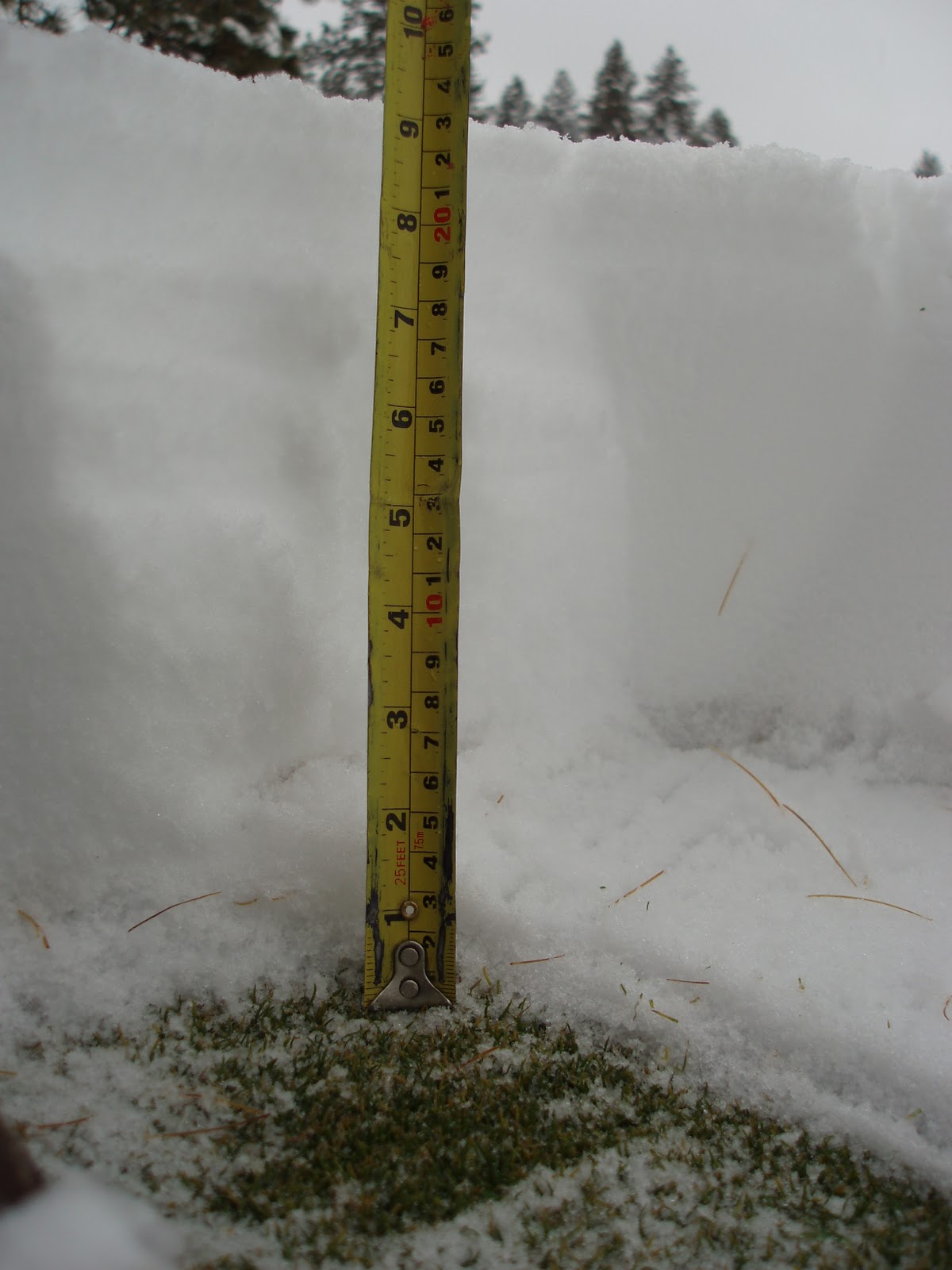
Snow Depth on #4 Green
Generally, there is enough snow cover on all greens to give us an insulating layer.  Some surfaces have remained thawed and should be good for rest of winter.  Others that were semi-thawed are now frozen and, along with the greens that remained frozen since the beginning of the season, have a pebbled ice surface of maybe 1/2  inch thick.  The ice still lacks any real cohesiveness but is probably solid enough to prevent damage to the surface during snow removal in the spring.

"Pebbley" ice and Grass on #4
Because of the greens it is on (most don't see much sun this time of year) and the fact that it is removed fairly easily all we are going to do is watch it and make sure it doesn't grow thicker and/or more dense.  If conditions change we'll begin pulling random turf plugs and decided on a course of action based on what we see.  I'll keep you updated.


Thursday, November 24, 2011

Week of November 20th

The was not the weather I wanted in the middle of November!  After that nice 15 cm of snow last Thursday we had another 11 cm come Tuesday a.m.  However, that was followed by one inch of rain over the next 2 days!  By the end of the rain the snow had been compressed 50%  to just to over 12cm.

Just under 24cm snow Tuesday a.m


Just under 12cm (radio is 12cm to base of antenna) on Thursday

I was fairly sure ice would appear on the surface of the frozen greens but as of today, Thursday, November 24 there doesn't appear to be any ice on any of the surfaces I checked.  Even better was the fact that those greens that were frozen seem to have thawed slightly which is maybe why no ice developed.  The forecast is for fairly normal weather (flurries, highs near zero and lows around -4 degrees Celsius) which is good.

Situations like this are far from my favorite but they do help develop a data base of experience which can aid in making decisions next time out.  Before we went and checked each green yesterday, I was under the assumption that a rain event of that size would be a problem since that has been the case in years past (anybody remember 18 G the spring of 2008?).  Even after having the worst case scenario I talked about in the previous post play itself out and things now appearing "rosy" I hesitate to comment on how the turf will overwinter.  Heck, we still have one week of November left!  I've been spraying the greens as late as December 14th so, suffice to say, we are not out of the woods yet.