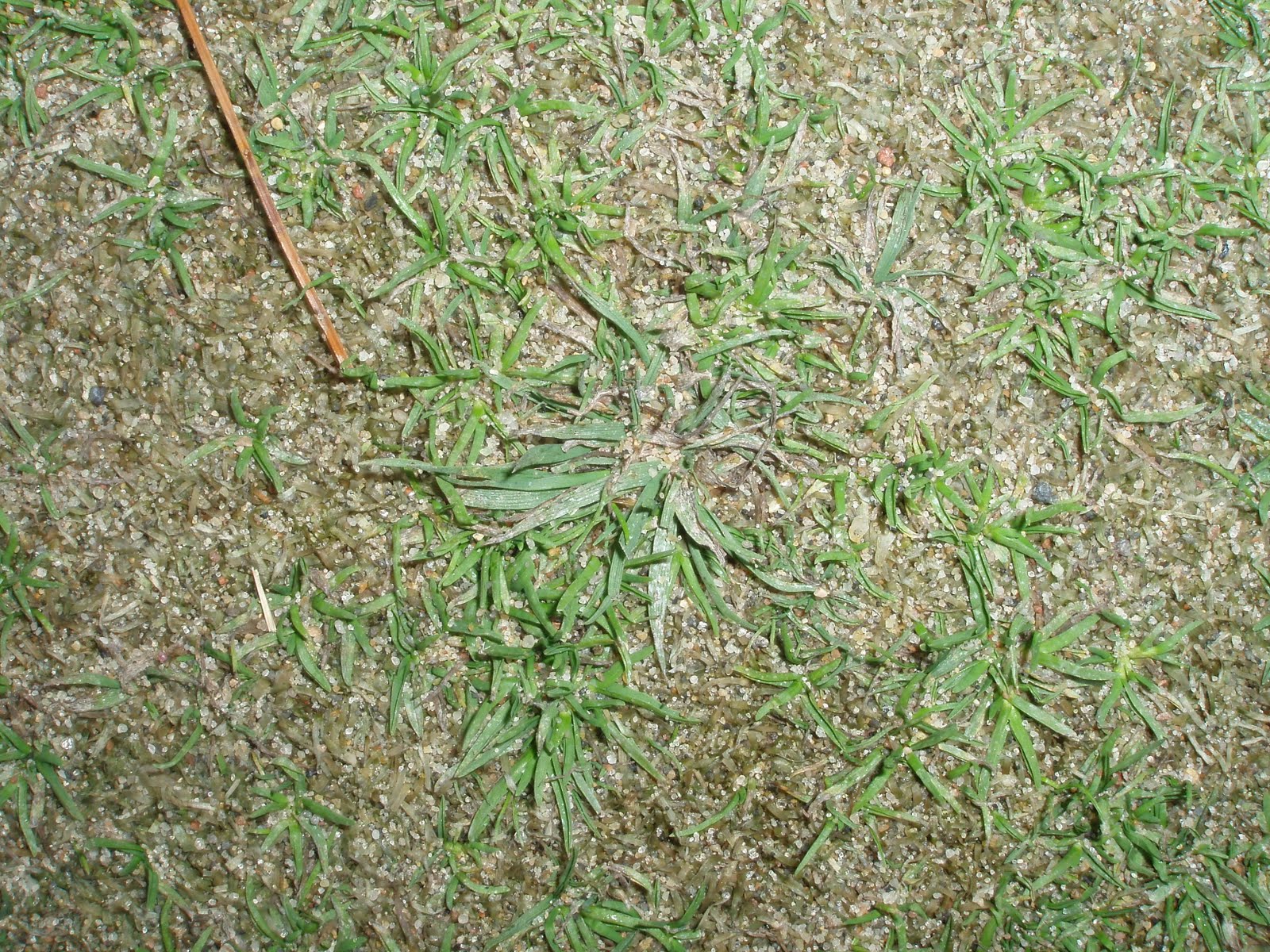
As part of the routine maintenance we finished aerating all the putting greens on the course last week. Everybody accepts the necessary evil of aeration but nobody likes it including the crew that has to do it. The shallow aerating performed this time out was to get oxygen down to the roots. Traffic from maintenance and play compacts the upper few inches of the root zone resulting in a decrease of available oxygen for the roots.
A quick and brief review of plant biology: grass is an autotroph a term which means it can create its own food. The process is called photosynthesis and the end products are glucose and the byproduct oxygen. Grass will use the "food" it created in photosynthesis to grow. The energy required for growth comes from a process called respiration which requires atmospheric oxygen (i.e. the plant has to absorb it). Seems strange that plants can create oxygen on one hand but on the other hand still need to absorb oxygen.
Another reason for aeration is removal of thatch from the upper surface. Thatch will affect nutrient availability, water peculation, playing conditions, incubate diseases, and contribute to poor/shallow rooting. A general rule of thumb is to aerate two times a year with 5/8 " hollow tines just to keep up with the thatch created by the turf in one growing season. The recommended volume of displaced material is from 20-25% per year. That translates in to 2 aeration's using 1/2" tines on a 1.25" spacing followed by two 1/4" aeration's on a 1.25" spacing throughout the growing season. Not goin' happen.
We keeping trying different things to find an agreeable process that provides a benefit to the turf with a limited disruption to playing conditions. This time out we used 1/4" tines on a 1.5x1.5 spacing that resulted in about 3% removal of organic matter. We picked the cores with a sweeper bought this spring and followed up with a medium top dressing. A traditional aeration requires the course close on an afternoon with any number of temporaries in play the next day while we top dress. Also, we require two aerators (we borrow one) two top dressers, 4 people to collect cores, 1 person to broom in the sand; 9 people. This time we used one person to aerate, one person to collect cores, one person to blow debris, one person to top dress: 4 people. We were able to do 7 greens/day with no closure and no temporaries.
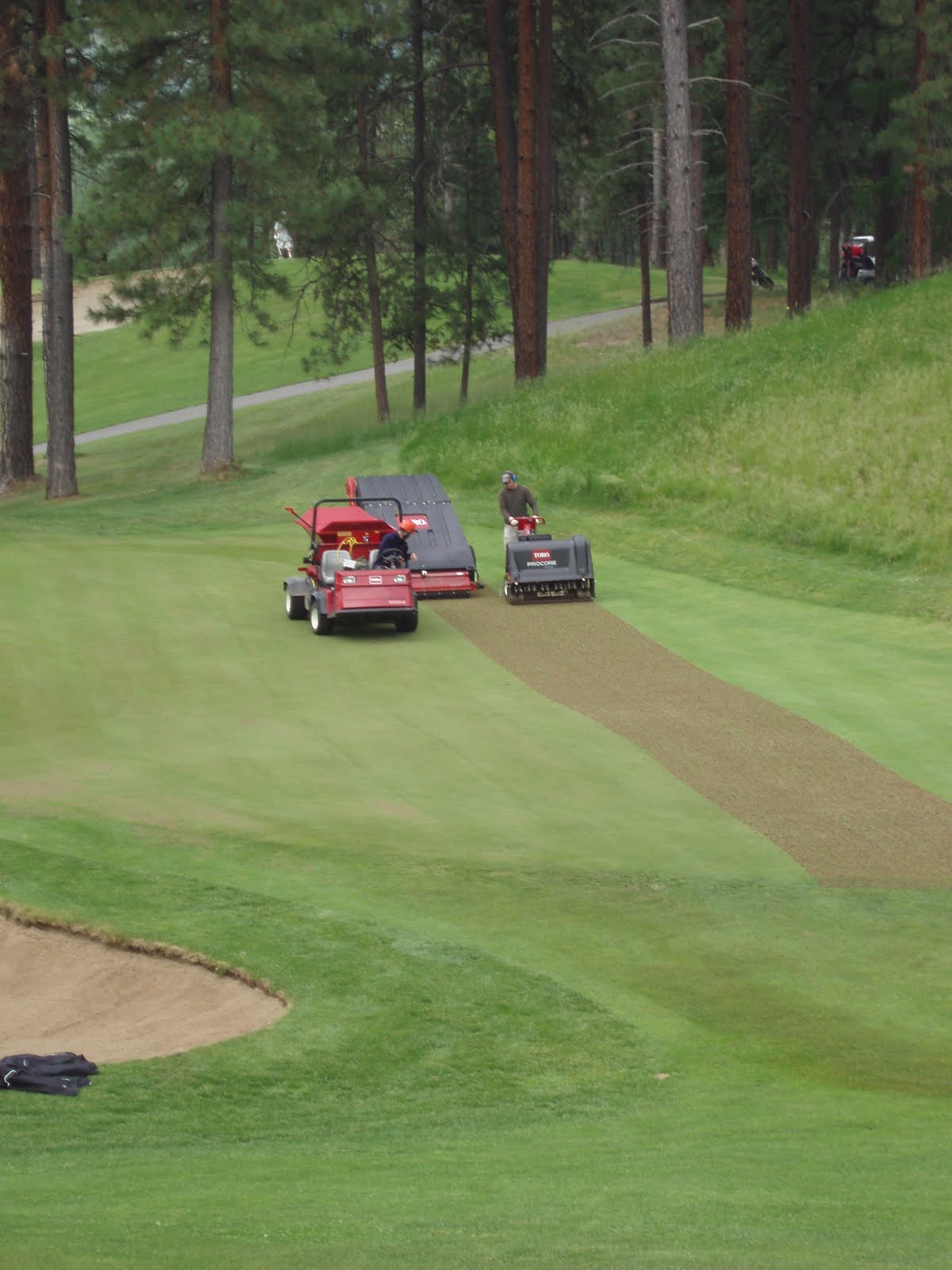
The hope is we are able to perform 2-3 of these aerations over the golfing season (May, June, August) followed by an aeration with larger holes once we close for the season which would remove about 9-15% of the surface area (depending of the type of fall aeration: hollow core vs. verti-drain). Time will tell.
Thursday, July 8, 2010
Friday, July 2, 2010
Fertilizing Fairways
The past 10 days or so have been very busy with lots of maintenance getting done. This post will touch on the recent fertilizing of the fairways and roughs.
It takes about 2 to 3 days for us to fertilize all the fairways and rough using anywhere from 2.5 to 4 metric tonnes of fertilizer. Ideally, you want to fertilize in the spring when soil temperatures have risen to around 55 degrees F (or 10 degrees) and the turf has just started its first growth cycle of the season. That way there is sufficient nutrients available for uptake for development of new tissue. We were late by a couple weeks mostly because of the weather and other matters kept us from fertilizing any sooner.
This particular application has the analysis of 21-3-21 (FYI the numbers on a fertilizer bag represent the percentage of Nitrogen, Phosphorous, and Potassium a.k.a NPK. They don't add up to 100% since NPK are only the individual elements of the compounds that make up the whole fertilizer product). We apply at a rate ranging from .5lbs to 1lbs of actual N per 1000 sqft (another FYI: actual N is calculated by taking the weight of the bag multiplying it by the the number representing nitrogen on the bag and dividing by 100. For e.g. 21-3-21 comes in 55lbs bag so: 55 x 21/100 =11.55 lbs of actual N in one bag. At a rate of 1lbs/1000sqft one bag of 21-3-21 can be applied to an area of 11,500 sqft. This same calculation can be done for Phosphorous and Potassium as well.) After we have decided on a rate we need to calibrate the tractor spreader (and walk behind spreader) to achieve the desired rate. We use a big bag and run the tractor spreader for a set time at a set speed and then weigh the fertilizer collected. We do this over and over until we have the desired setting. That is stuff is probably only interesting to me but it applies to any rate calculation for any granular fertilizer so feel free to use it for your yard.
The biggest hurdle we have faced recently has been the cost increase of fertilizer by 40%. A couple ways to control cost is to use different fertilizer types. More expensive fertilizers have more nutrients and/or different nutrient formulations (e.g. methylene urea's) than a cheaper brand with the same NPK analysis. There is a trade off with using cheaper formulations and usually this is the length of time the fertilizer works (i.e. a fertilizer with a higher percentage of quick release Nitrogen is cheaper than a product with more slow release) and the compounds used in creating the fertilizer are usually higher in something called the "salt index" which can have deleterious effects on the turf. The other more obvious way to deal with cost increase is to fertilize less area. We are doing both when we fertilize. Those rough area with an increasing population of clover are areas which have not seen a high quality fertilizer or, in some cases, any fertilizer for a few years.
Our next major fertilization will take place in late summer/early fall when the turf enters its second major growth cycle before going dormant. The analysis will be similar with more micro nutrients and a different Nitrogen source which will still be available in the early next spring when soil temperature start to climb.
There is way more information to cover with respect to fertilizing and plant nutrition but I can tell peoples eye's are glazing over so I'll leave it there. Click the following link and read what the USGA had to say about the greens at the US open and see if the first paragraph sounds like any other place you might know of.
http://www.usga.org/news/2010/June/Beauty-In-Eye-Of-Beholder/
It takes about 2 to 3 days for us to fertilize all the fairways and rough using anywhere from 2.5 to 4 metric tonnes of fertilizer. Ideally, you want to fertilize in the spring when soil temperatures have risen to around 55 degrees F (or 10 degrees) and the turf has just started its first growth cycle of the season. That way there is sufficient nutrients available for uptake for development of new tissue. We were late by a couple weeks mostly because of the weather and other matters kept us from fertilizing any sooner.
This particular application has the analysis of 21-3-21 (FYI the numbers on a fertilizer bag represent the percentage of Nitrogen, Phosphorous, and Potassium a.k.a NPK. They don't add up to 100% since NPK are only the individual elements of the compounds that make up the whole fertilizer product). We apply at a rate ranging from .5lbs to 1lbs of actual N per 1000 sqft (another FYI: actual N is calculated by taking the weight of the bag multiplying it by the the number representing nitrogen on the bag and dividing by 100. For e.g. 21-3-21 comes in 55lbs bag so: 55 x 21/100 =11.55 lbs of actual N in one bag. At a rate of 1lbs/1000sqft one bag of 21-3-21 can be applied to an area of 11,500 sqft. This same calculation can be done for Phosphorous and Potassium as well.) After we have decided on a rate we need to calibrate the tractor spreader (and walk behind spreader) to achieve the desired rate. We use a big bag and run the tractor spreader for a set time at a set speed and then weigh the fertilizer collected. We do this over and over until we have the desired setting. That is stuff is probably only interesting to me but it applies to any rate calculation for any granular fertilizer so feel free to use it for your yard.
The biggest hurdle we have faced recently has been the cost increase of fertilizer by 40%. A couple ways to control cost is to use different fertilizer types. More expensive fertilizers have more nutrients and/or different nutrient formulations (e.g. methylene urea's) than a cheaper brand with the same NPK analysis. There is a trade off with using cheaper formulations and usually this is the length of time the fertilizer works (i.e. a fertilizer with a higher percentage of quick release Nitrogen is cheaper than a product with more slow release) and the compounds used in creating the fertilizer are usually higher in something called the "salt index" which can have deleterious effects on the turf. The other more obvious way to deal with cost increase is to fertilize less area. We are doing both when we fertilize. Those rough area with an increasing population of clover are areas which have not seen a high quality fertilizer or, in some cases, any fertilizer for a few years.
Our next major fertilization will take place in late summer/early fall when the turf enters its second major growth cycle before going dormant. The analysis will be similar with more micro nutrients and a different Nitrogen source which will still be available in the early next spring when soil temperature start to climb.
There is way more information to cover with respect to fertilizing and plant nutrition but I can tell peoples eye's are glazing over so I'll leave it there. Click the following link and read what the USGA had to say about the greens at the US open and see if the first paragraph sounds like any other place you might know of.
http://www.usga.org/news/2010/June/Beauty-In-Eye-Of-Beholder/
Tuesday, June 22, 2010
How much has it rained? Or better yet, How little irrigation have we used?
It is no news flash to anyone that the weather has been wet. We keep informal weather records (highs, lows, precipitation amounts, etc) for reference. Same can be said for the water output of the irrigation pump station. Over the last 6 weeks of 2010 we have used 3.5 million gallons of water. Although that may sound like a lot of water but one needs to know that (best case scenario) the irrigation system at KGC can distribute about 450, 000 gallons/night when we are watering everything. So really 3.5 million gallons is only just under 7 complete irrigation cycles (i.e. 7 nights of watering everything). In the past we have usage as been: 2005-8.3 million gallons, 2006-10.8 million, 2007-12.9 million, 2008-7 million, and 13 million gallons last year.
The amount of rain fall (approximately) recorded at KGC this year is 52mm for May and 32 mm for June (not including this weekend). The weird and sort of disappointing part is, according to statistics for the past 30 years, the average rainfall for May is 42 mm and for June is 51mm. It sure feels like an above average year for rain to me! To be fair, Environment Canada has a little disclaimer regarding the accuracy of the weather records for Kimberly since during weekends and holidays no weather data is recorded. One tool I've been looking into for the past couple years has been a weather station for KGC that would log environmental conditions. There is numerous models ranging from the low $100's up to $15,000. Expensive weather stations pay for themselves over time since they can be integrated into the irrigation system and save on water and power usage. At this point in time we are lucky in that water costs are still relatively cheap at KGC so any weather station we would buy would be on the very low end of the price range.
Golf course wise the weather seems to have come during the week days which really cramps our style since most staff and work hours occur Monday to Friday and we depend on good weather conditions to get things done. Most of the cart path sodding is completed. Any remaining areas next to cart paths will be finished using aeration cores such as described in the May 19th posting. We have begun to replace the damage turf on the collars and aprons on some of the front nine greens and will continue for the rest of the following week. If possible we will begin to aerate parts of those fairways that were damage this past winter and try to get some more recovery in the weak areas. We are falling behind with respect to flower beds, string trimming, fertilizing, green aeration, and bunker maintenance. I am hoping to get caught up by bringing on more staff (school is out soon) to help with projects and routine maintenance.
The amount of rain fall (approximately) recorded at KGC this year is 52mm for May and 32 mm for June (not including this weekend). The weird and sort of disappointing part is, according to statistics for the past 30 years, the average rainfall for May is 42 mm and for June is 51mm. It sure feels like an above average year for rain to me! To be fair, Environment Canada has a little disclaimer regarding the accuracy of the weather records for Kimberly since during weekends and holidays no weather data is recorded. One tool I've been looking into for the past couple years has been a weather station for KGC that would log environmental conditions. There is numerous models ranging from the low $100's up to $15,000. Expensive weather stations pay for themselves over time since they can be integrated into the irrigation system and save on water and power usage. At this point in time we are lucky in that water costs are still relatively cheap at KGC so any weather station we would buy would be on the very low end of the price range.
Golf course wise the weather seems to have come during the week days which really cramps our style since most staff and work hours occur Monday to Friday and we depend on good weather conditions to get things done. Most of the cart path sodding is completed. Any remaining areas next to cart paths will be finished using aeration cores such as described in the May 19th posting. We have begun to replace the damage turf on the collars and aprons on some of the front nine greens and will continue for the rest of the following week. If possible we will begin to aerate parts of those fairways that were damage this past winter and try to get some more recovery in the weak areas. We are falling behind with respect to flower beds, string trimming, fertilizing, green aeration, and bunker maintenance. I am hoping to get caught up by bringing on more staff (school is out soon) to help with projects and routine maintenance.
Monday, June 14, 2010
Poa in full "flower"
Another entry about Poa annua. It has been discussed enough so hopefully everyone knows what Poa is. Every spring both types of Poa (annual and perennail) produce an inflorescence that makes all the green surfaces appear white. The seeds produced by the annual bio type will germinate either this fall or sometime next spring when conditions favour germination. The seeds produced by the perennial bio type will germinate soon after they are produced this year. It is pretty tough to distinguish visually between the annual and perennial bio types but it doesn't make a difference as long as there is seed being produced to help fill in bare spots. In Canada there are very few products available to manage Poa and its seed head. In the U.S. there is a selection of pre-emergence, post-emergence herbicides, and products for seed head control. One post-emergence herbicide just registered for use on golf course (actually the only one) in Canada is able to selectively remove Poa from bent grass greens and will help all the recently build golf courses keep their green surface free of Poa. Use of such a product on the green surfaces at KGC is not feasible because of the large percentage of Poa on the green surface. The only other tool available is a growth regulator which acts to limit the elongation of turf. If you time it right the product will not suppress seed head but act to keep the stalk producing the seed head shorter and deeper in the the turf canopy. However, this product I'm describing is better for controlling growth of leaf tissue. It has the added benefit of encouraging lateral growth and will help increase turf density and being dense, with respect to turf, is a good thing.
Tuesday, June 8, 2010
Sod Work
This week has the crew laying down sod at different spots throughout the course. Mostly, sod will go to finish off the tie ins from the cart path renovations started last fall (see "Week of May 23" posting for more info). This time we ordered some big roll sod which is 400 square feet per roll and is far quicker and easier to use if the location allows it. Two staff were able to transport and roll out 1600 square feet of sod in 3 hours; impressive sounding only if you've ever had to lay sod! Since the rolls weigh over 1000 pounds each we had to come up with a counter weight idea that would help the Bobcat keep all four wheels on the ground. The best ideas are the simplest and one of my guys came up with hanging a bag of sand off the back end. Driving with the bag hanging off the back end reminded me of seeing my kids when they had full pants when they were babies so we named it the "Bobcat diaper".

Bobcat with a full diaper unrolling sod
Since we had over 7000 square feet of big roll we had to unload all the big rolls in one spot and then use this area as a staging area. The Bobcat could carry a roll and a second roll could be loaded and hauled into back of one of the run around vehicles and unloaded when it was needed. The vehicle pictured below is a real work horse and has a payload of just under 1200 Kg (that's around 2500 pounds, that's over a ton!)
Workman carrying a big roll
Aside from tying in the cart path edges we will also use some of this sod in our nursery and use it on the course when needed throughout the year. It may seem like over kill to buy more sod than you need however one needs to consider firstly the cost of delivery which is the same if you order a full or partial truck and secondly the fact that the price per foot goes down as you order more. Sod is like buying toilet paper on sale....you might as well get as much as you can afford because you know you're going to need it one day.
Sunday, May 30, 2010
Week of May 23
This week was somewhat more productive with a couple twists. We began to prepare cart path areas for the arrival of sod on this coming up Monday but snow over the weekend in Alberta means sod could be delayed until next Monday (following the Wood Valence) since the fields where the sod is grown are too wet to work on with the sod harvester. There will also be some trees included to replace some that did not make the winter and to replace some of the mountain ashes that seem to be a favorite of the bears in the fall.

One of the Many Fusarium Spots
Another disease we are dealing with is occurring on those greens that over wintered poorly and had to be over seeded. Again, conditions like we are experience this spring (poor air circulation, cool, and damp) favour development of a disease called Pythium Root Rot. Generally, this disease is not a problem and can often be ignored. This year, however, there is new seedlings that lack a well developed root mass and established turf that is still trying to recover from this winters stresses; as a result, the disease was starting to affect plant health and it became necessary to treat it.
The cool, humid weather helped the development of some turf diseases that required treatment. One disease, Microdochium Patch (a.k.a. Fusarium and/or Pink Snow Mould ---multiple names which refer to the same disease. Just depends on the conditions when the disease occurs.) became prominent last week on certain greens. We pretty much plan on getting Fusarium at least once or twice every spring and as late as mid June if the weather is cool and wet. There are indicator greens which are more prone (same old, same old conditions: shade, poor air circulation, high percentage of Poa annua, & excessive fertility) to developing the disease and usually we base the level of treatment on the severity of disease present on those greens.
One of the Many Fusarium Spots
Another disease we are dealing with is occurring on those greens that over wintered poorly and had to be over seeded. Again, conditions like we are experience this spring (poor air circulation, cool, and damp) favour development of a disease called Pythium Root Rot. Generally, this disease is not a problem and can often be ignored. This year, however, there is new seedlings that lack a well developed root mass and established turf that is still trying to recover from this winters stresses; as a result, the disease was starting to affect plant health and it became necessary to treat it.
Spraying for Pythium Root Rot
Wednesday, May 26, 2010
"Give it a month and some heat"
Its been just over a month since opening all 18 greens for play and some are still struggling but most are coming along. A lot of the growth in the thin areas you maybe seeing appears to be the regeneration of Poa annua from the crown. If you imagine grass looking like a onion plant think of the onion bulb as analogous to the crown of the grass plant. It appears that some grass plants were not completely destroyed last winter as some of the new growth showing on the greens is coming from crowns not seedlings. I can make this observation now that the turf has grown as it is easier to distinguish between bent grass species and Poa grass species once they have both matured. Some of the over seeding has worked but the young seedlings are struggling with the regular play and maintenance. To get a good look at the two species I'm talking about just double click each photo.

Bent grass in center of photo.
Notice the fat leaves with prominent ridges
running the length of the blade.

Poa annua in this photo has a thinner blade
that sometimes appears folded.
We've been pretty generous with the fertility and height of cut (H.O.C.) on the greens to aid in recovery and to get some good turf for the remainder of the season. With the first tournament schedule for early June we will need to begin lowering the H.O.C. closer to our more usual summer height soon. You can't blame all the problems on a grass species but a quote that sums up Poa best for me is "When Poa annua is good, it's the best; when it's bad there's not much worse"
Bent grass in center of photo.
Notice the fat leaves with prominent ridges
running the length of the blade.
Poa annua in this photo has a thinner blade
that sometimes appears folded.
We've been pretty generous with the fertility and height of cut (H.O.C.) on the greens to aid in recovery and to get some good turf for the remainder of the season. With the first tournament schedule for early June we will need to begin lowering the H.O.C. closer to our more usual summer height soon. You can't blame all the problems on a grass species but a quote that sums up Poa best for me is "When Poa annua is good, it's the best; when it's bad there's not much worse"
Subscribe to:
Posts (Atom)