Thursday, June 7, 2012

Trying to Figure it Out

It's probably the farthest thing from your mind but this post is a review of winter damage we experienced this year.  One thing I am learning is just as it takes multiple inputs to make the turf appear good it also takes more than one thing to cause damage.  I am always looking for common denominators to explain damage.  It's only with the benefit of hindsight do I think that one of the factors impacting spring conditions was the level and condition of the snow cover on the greens this past winter.  All the areas damaged this spring were prone to poor snow coverage during one or multiple times through out this past winter.

What really got me thinking about this was comparing the snow pack (depth and consistency) between 12 and 13 greens.  In late February there was 8" of tight corn snow on 12 green over a 1/2 of surface ice.  On that same date 380 yards away on 13 (a green with the same aspect) there was 16" of loose corn snow over an ice free and thawed surface.  Why?  Both are surrounded on the left and back by trees but the trees on 13 are much farther away so, it is my theory, that the trees influence (in this case shelter from snow) was limited; i.e. less shelter from the trees on 13 so more snow on that green versus 12.  

The damage on the front left of 1 green, I think, was caused by the trees acting as a heat sink.  During sunny days they would absorbed heat and radiated it at night.  Stupid sounding I know but I've been around enough times to see the snow melt first on the south west side of these trees to know that it is a very common occurrence.  This happened a few times early in the spring and combined with the snow events we experienced in March I think that area went through a series of melts that created a number of freeze/thaw cycles that ultimately killed the turf. 

Front Left #1 Green
What about the wrinkles of green under the tarp on #1 green?  This was where the semi-permeable tarp created insulating air gaps between the turf and the ice (a case for insulating greens prone to early season melting, i.e. bubble wrap).

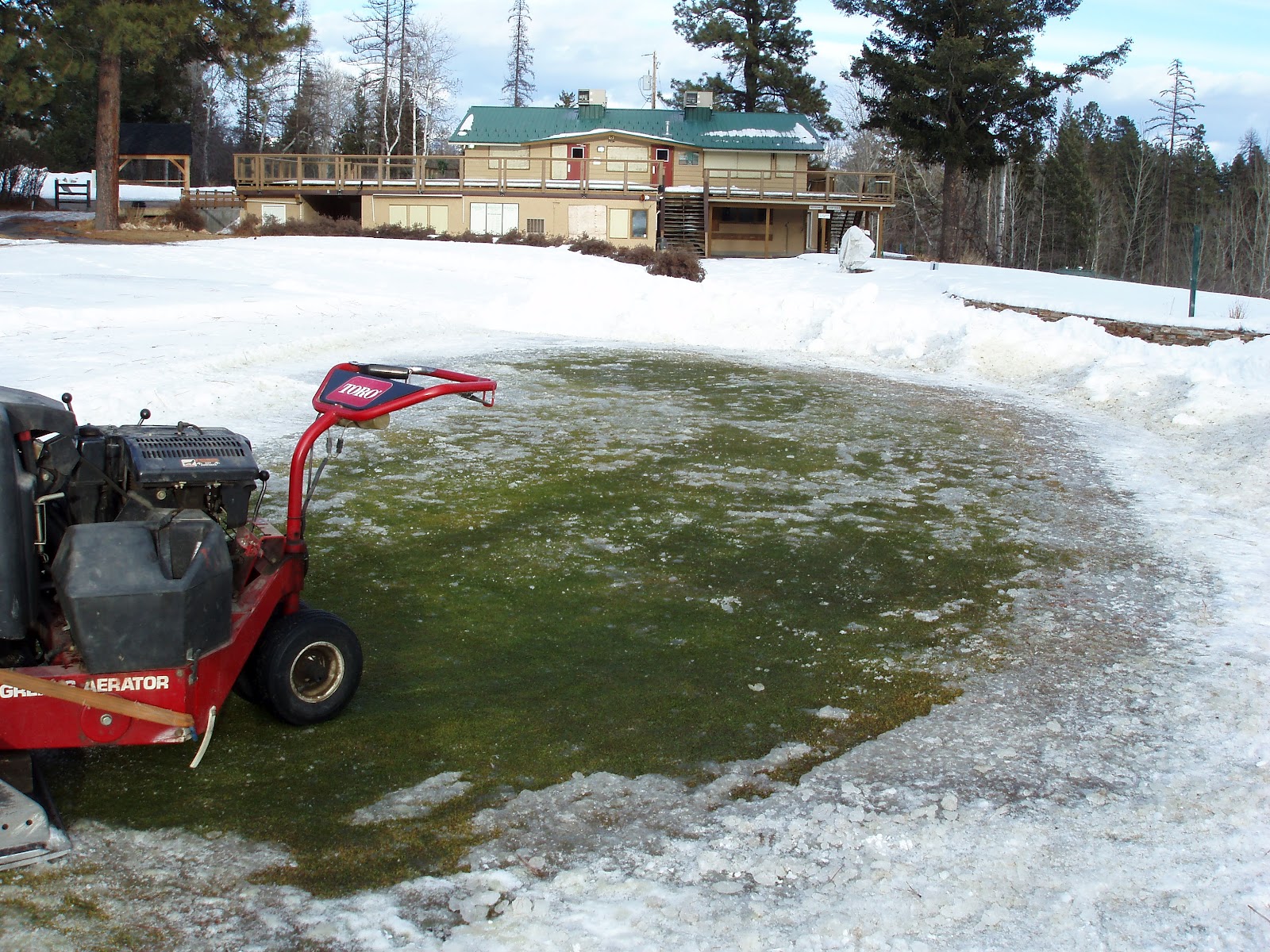
Now the putting green.
New Putting Ice Layer
It too is prone to early season melting and freeze/thaw exposure.  I've never worried about it because of the bent grass component.  This time out I think the green was unhealthy going into winter and did not have the CHO reserves to cope with the freeze/thaw and ultimate anoxia created from the ice layer that developed.  For this green it was probably that one-two punch that caused all the problems since the lower half, which was completely playable early on, had the same lack of fertility but no ice.

What about 9 green? Remember this?

Ice Removed From Back #9 Green
I exposed it thinking the damage was done so what could I lose?  Interestingly enough while the back has mostly recovered it is those area on the right side that I did not touch in February that are still slow to come.

#9 Green One Day After Black Sand Melted Snow
Probably that damage relates to the melting of the snow I did in early March.  During that time the temperatures ranged from -14 to +10 and I think the mistake lies in melting the snow too fast (creating free water) and too early.  At the time I was concerned with a slow melt and freeze/thaw damage.  It may have been better to blow what snow I could, melt any ice and then tarp the green.

All these areas struggle with shade during the spring and fall but so do other greens and they weren't damaged.  But, again I think, a possible common denominator is the condition of the snow cover.  Most all other greens had a deep snow pack and were slow to melt.  The real kicker for me is the damage on 12 green.  The worst area is the spot where I exposed it very early thinking I was limiting the ice damage.  The rest of the green that I left covered was still damaged but has recovered faster than that back tier that was exposed earlier -- opposite as to what has occurred on #9 green.

Next winter it will be a different story.  I know this is long winded and awkward and maybe I've over explained stuff but I think with the way this spring has shaped up for golf courses in this area people should know that the choices made when dealing with winter can have different results within a golf property let alone different results between golf properties.

Sunday, May 27, 2012

Driving Range Opening Date

Looks like we will open the range this coming Wednesday, May 30 or at the very latest this coming Friday. At this stage,  the sodded tee deck is fairly established and is not the real hurdle.  The time line I mentioned in the March 14th post  did not happen exactly as planned but we are more or less where I had hoped.  It took us longer to get the area prepared and we didn't started seeding until May 10 (versus May 4 which I had planned).  The good news was there was germination happening after 9 days (May 19th) and a definite green sward by 14 days (May 24th).  The seed blend we used was a Perennial Rye and Kentucky Bluegrass blend.  Rye can germinate in 7 to 10 days at optimum temperatures and Kentucky will germinate in 14 to 30 days.  Before opening the range my hope was to have the rye well on its way and the Kentucky starting to grow but, as previously mentioned, preparing the seedbed took longer so we were late to seed.  Not an ideal situation but not the end of the of the world either.

We still need to repair the netting, add sand to the practice bunker, and complete the tie in around the edges.  The way it is going with regular on course maintenance taking up most of the mornings we will probably work on the range during the latter half of our days.  I just added some picks showing various stages for you to browse.

D-9 Pushing Material Last Fall
Trenching in Irrigation
Fall 2011
Trenching in Control Tubing
Spring 2012
Preparing for Seeding
Spring 2012

Finishing off Seeding and Watering it in
Spring 2012

17 Days After Seeding
Not a lot of pictures.  I missed quite a few good pictures showing the process since I wasn't always enough on the ball to remember my camera plus some of the pictures I did take are sort of boring.

Most likely the new seedlings will require babysitting for a bit and we may have to visit some of the irrigation heads but hopefully the problems and inconveniences are few and far between.

Sunday, May 20, 2012

Provincial Report on Cosmetic Pesticide

This past week the committee appointed by the provincial government released its report.  Go to  Special Committee on Cosmetic Pesticides report for the full report (or read the Executive Summary at the beginning of the full report for the quick and dirty version)


This particular "e-consultation" generated the most submissions ever to a BC parliamentary committee with 8600 groups and individuals participating.  Over 7000 e-questionnaires were submitted and almost 5,000 supported a ban on the sale and use of pesticides for cosmetic purposes.  The committee came up with 17 recommendations that include restricting the sale and use of Commercial-class pesticides, better enforcement, and better training and public education related to pesticide use.  


I realize I am just plagiarizing the report so maybe it is better you go and read it.  Reading between the lines a bit I would guess that the Liberals do not support a provincial ban since the Executive Summary references a split along "party lines over the justification for a province-wide ban on the cosmetic use of pesticides" and a majority of the committee members were from the Liberals.


At present, golf course will not be influenced negatively by the 17 recommendations.  Stay tuned.  We see what the next election brings.  


With respect to the course I need to explain that I am not doing any updates because nothing is going on but because a tonne of stuff is going on.  Spring is busy with training staff and getting the course ready.  I hope to play catch up so keep checking back.  Topics I want to cover include the progress on the range, review of our fungicide "trials", and a discussion about how the course recovered from winter including WTFrig is up with the upper putting green.


Tuesday, May 1, 2012

My definition of Cosmetic

The debate is still on and we are still waiting for a formal response/recommendation from the Committee on Cosmetic Pesticides ( see We got a problem.... post for refresher).  I had a goofy idea last fall.  I wanted to stress the importance of the cosmetic pesticide debate to people who golf at KGC.  We chose an area on #1 fairway and deliberately did not spray it with our overwintering fungicide.  To encourage as much involvement as possible on the pesticide issue I wanted to get peoples attention so we spelled out the word "WHY" with garbage bags and sprayed over top of the bags.
The "WHY"
The hope was that the areas covered with the bags would be riddled with disease while the surrounding area would be green and healthy and show no disease.  When people asked what the "WHY" meant I would use that question as my lead-in to the cosmetic pesticide debate.  However, stuff happens.  In the race to get everything ready for winter we forgot the location of the "WHY" and sprayed right over it and, as a result, the area I was hoping to act a show piece for disease came through looking great!?!  I guess the good news / bad news is there is lots of other areas to show the importance of an overwintering spray to KGC but you need to know where to look.  Take a look:

#4 Fairway

The left side of picture shows the control achieved with the low rate of an overwintering fungicide while the right side had no fungicide applied and is covered with snow mould.

I like to leave some areas on the golf course untreated for cost reasons but also for reference points to get an indication the disease pressure from year to year.  The following pictures are from 8 fairway. 
Start of #8 Fairway: not treated
The rest of #8 Fairway: treated
Had we not treated sections of  number 8 the whole fairway would look like the area in the first picture. 


#12 Fairway

I took the picture of 12 fairway from on top of the hill on the right of the fairway.  The line between treated and untreated on the fairway is obvious.

IMO, I don't think the disease pressure was exceptionally high this year based on what I've seen on untreated areas of turf.  I am comfortable with the rate that we used and I would be hard pressed to give up treating fairways based on cost or legislation.  How long will it take for those area we didn't spray to recover?  This is where Poa is good because I know we have a huge seed bank in the soil so, ultimately, the grass will come.  How long it takes depends on weather and other stresses (play, mowing, etc).  There is things we can do to speed recovery but with this years budget we don't have the man power or necessary equipment to address these areas adequately.

As you play the course this year keep an eye on those areas shown in the previous photo's and see how long it takes for those fairway areas hit by snow mould to recover to a playable condition.  For me, none of the sprays we did last fall were for cosmetic reasons.  There is too much golf to choose from locally to risk not having the course in the best possible condition.  Unlike damage from other winter stresses (ice, crown hydration, etc), I have some level of control on how severe winter disease damage can be by applying fungicides.  Actual risks associated by application of products for cosmetic reasons are, perhaps, best demonstrated by this photo:

Saturday, April 21, 2012

Opening Update for Week of April 22

A short note as opening day nears.  The course will open the front nine on Wednesday, April 25.  All greens will be in play but not necessarily all the bunkers (same old, same old).  We have aerated and top dressed 11 greens  and will finish the rest off next week in anticipation of all 18 holes opening for Saturday, April 28.

Aside from the aerating we will continue with starting up irrigation, cleaning up tree litter, preparing the bunkers, and mowing turf.  Mostly things are good with some nuisance problems on a few greens. I'll go into more detail once as the opening date gets closer.

Friday, April 13, 2012

Some shots to whet your appetite

We mowed a couple greens today so I thought I would post some pictures showing what things look like.  Typically, the impact of the pictures is lost once I see them on the computer so I encourage people to go for a walk around and take a look.

First Mowing #1 Green
First Mowing #9 Green
Both these green had tons of grass on them.  Both have some small weak areas that are slow to come but now that they have been mowed and the soil temperature continues to go up I can start in on getting them up to speed, so to speak.  Interestingly enough all the problem area are in the shade.....hmmmm....strange........

Don't get too excited, however, since there is still snow out there:

#14 Fairway

Next week we will continue to mow some of the warmer greens and probably begin to work towards a opening sometime after next weekend.

Wednesday, April 11, 2012

Starting to See More Green

I know I've been lazy so I'll throw out this quick update.  Sunny days are helping and things have really moved over the past couple weeks.  Most greens are good with small problems on the usual suspects.  I am not sure why but the upper putting green (or some call it the new putting green) is dead.  That whole thing deserves its own post so I'll comment on that later.

The usual suspect greens are a combination of tarped greens and those other greens with a bit of a history of being difficult.  Time and heat are a good combination for most problems.

7G March 29

7G April 2
I was glad to see how quickly the plug greened up.  The problem, as is always the case in spring, is how to get the whole surface to green up that fast.


Take a look at these:

15 Green April 5
15 Green April 11
Soil temperature for the top picture was 12 degrees C while soil temperature for the the bottom picture was 15 degrees (temperature taken at about 1.5 inches below the surface).  One weeks time and an increasing soil temperature has made a big difference in the appearance of this green.  What I'm not showing you is the back of this green.  On April 5 soil temperatures were only 5 degrees C and the turf was very brown.  Today the soil temperature was 9.5 and the back looked like:

Back 15 Green April 11
No screaming hell but the point of all these pictures is to show how soil temperatures and not necessarily air temperatures are important in getting the turf to green up in the spring.